
Where Are the Artemis 2 Astronauts? Tracking the Orion Spacecraft in Real-Time
The crew of Artemis 2 is officially on their way to the Moon. NASA Administrator Jared Isaacman announced the successful execution of the critical translunar injection maneuver, which occurred 25 hours after launch. With this maneuver, the Orion spacecraft is now en route to the Moon, marking the beginning of its historic journey.
Key Milestones of the Mission
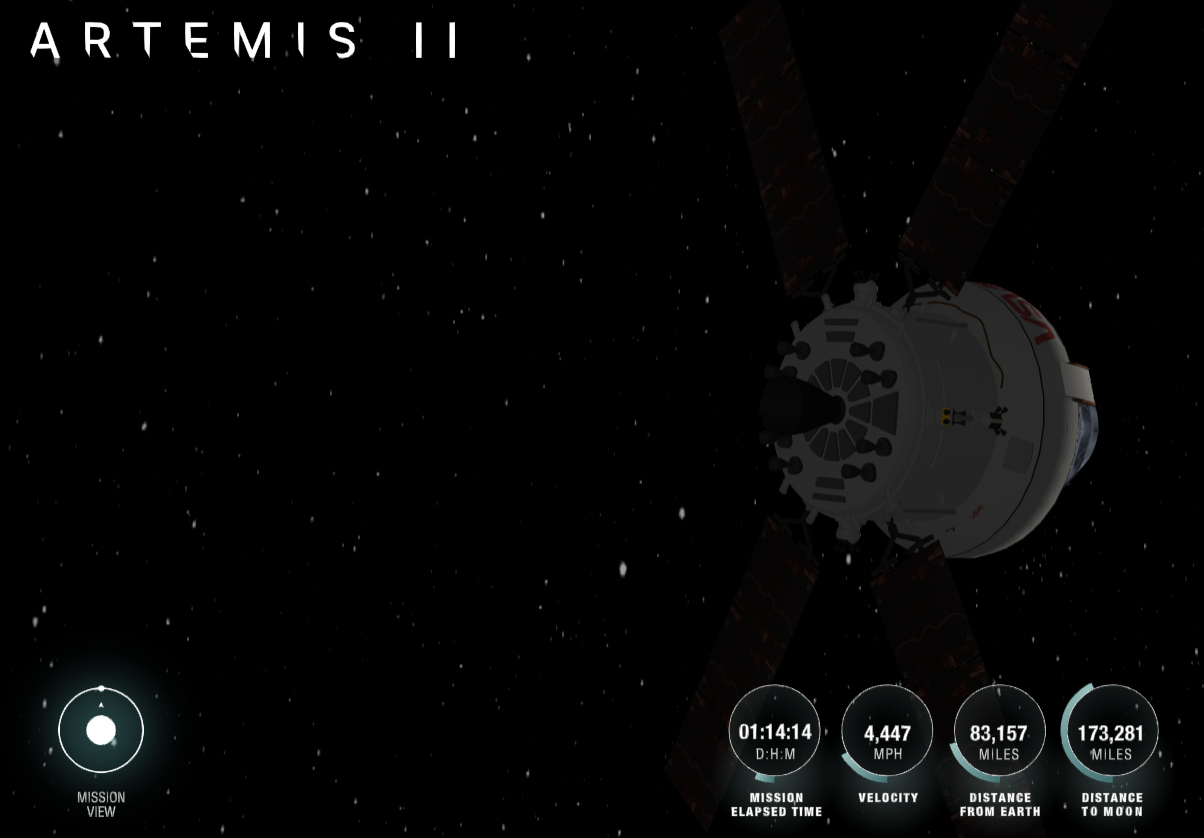
The Artemis 2 mission requires astronauts Reid Wiseman, Christina Koch, Victor Glover, and Jeremy Hansen to travel over 400,000 kilometers from Earth. If all goes smoothly, they will break the record set by the Apollo 13 astronauts, becoming the most distant humans from our planet. This incredible voyage can be followed in real-time through a specially designed NASA application called AROW (Artemis Real-time Orbit Website).
Real-Time Tracking with AROW
AROW enables the public to monitor the spacecraft’s location and its distance from Earth and the Moon. For instance, as of Friday at 14:50, Orion was approximately 278,000 kilometers from the Moon and traveling at nearly 7,100 kilometers per hour. The website also provides detailed information on the days, hours, and minutes of the journey. In total, the crew will be in space for 10 days, aiming to return safely to Earth by April 10, landing in the Pacific Ocean.
The Communication Backbone
NASA’s official tracking of the Orion spacecraft utilizes the Deep Space Network with strategically located stations in Spain, the U.S., and Australia. These stations provide constant communication coverage for NASA missions. In addition, NASA has partnered with 34 governmental and private organizations, including the Spanish company Integrasys, which developed technologies to track the spacecraft’s speed and trajectory.
Daily Life in Space
The mission’s big day is approaching: Monday, when the astronauts will orbit the Moon and fly over its far side. They will be the first people to observe some geological features of the Moon. After this, they’ll embark on a nearly four-day journey back to Earth, culminating in a critical re-entry phase that will test Orion’s thermal protection system.
Experiments and Observations
While the crew prepares to gather data and conduct scientific experiments during their mission, daily activities are diverse. For now, the astronauts are taking advantage of their journey to prepare for lunar observations and monitor their health continuously.
The AROW tool offers tracking capabilities, while onboard cameras allow the public to catch a glimpse of the astronauts’ daily lives. Recently, the crew showcased their relief following the successful translunar injection maneuver, sharing experiences from their early days in space.
Christina Koch, who previously spent 11 months aboard the International Space Station (ISS), joked about fixing a malfunctioning toilet aboard the spacecraft, referring to herself as the “space plumber.”
Coping with Life in a Capsule
Space travel poses unique challenges, including sleep. The astronauts sleep in bags anchored to the spacecraft. Commander Reid Wiseman mentioned that, surprisingly, it’s more comfortable than it seems. He remarked, “It’s comical, but more comfortable than it appears.” Koch’s sleeping position is so unusual that Wiseman described her as “suspended like a bat.”
To counteract the effects of microgravity, astronauts engage in 30 minutes of exercise daily with an inertial resistance device. In contrast, those aboard the ISS typically exercise for two hours each day because of the longer durations of their missions.
Awe-Inspiring Views
During press briefings, crew members expressed their amazement at the breathtaking views from their spacecraft. Wiseman reflected on a moment when they could see the Earth from pole to pole: “It was the most spectacular moment, leaving all four of us speechless.” Pilot Victor Glover added that viewing Earth from space offers a powerful perspective: “We are all Homo sapiens.”
In conclusion, the Artemis 2 mission not only signifies an essential step toward lunar exploration but also provides captivating insights into the life of astronauts as they journey beyond Earth.