
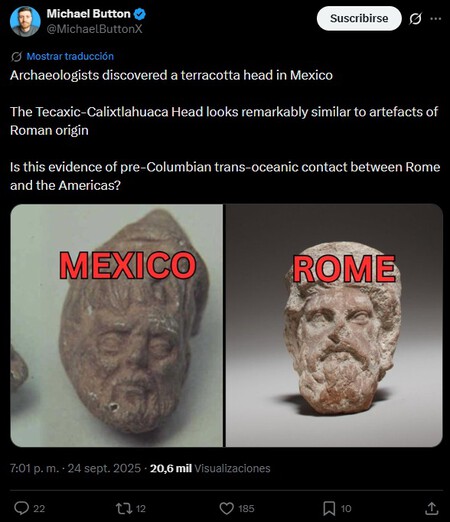
The Mystery of the Roman Bust in a Pre-Hispanic Tomb
Archaeologists often amaze us with their discoveries, yet few findings are as perplexing as the discovery of a Roman bust in a pre-Hispanic tomb in Mexico. This peculiar incident unfolded during excavations at the Tecaxic-Calixtlahuaca site, located 65 kilometers northwest of Mexico City, where a team led by José García Payón made this remarkable find 90 years ago.
A Fascinating Discovery
During the excavation, experts stumbled upon a funerary offering that included not only precious artifacts but also a distinctive terracotta head. This small bust, characterized by its bearded face and Roman features, has led historians to hypothesize about its origins, dating it to the 2nd or 3rd century AD. This raises an intriguing question: how did it find its way into a burial site sealed in the late 15th century?
Understanding the Context
The bust was not found in an easily accessible area; instead, it was buried under three intact layers of a pyramidal structure. This sealed context suggests that the artifacts have remained undisturbed since their burial, dated between 1476 and 1510. If the Roman bust was present, it must have been intentionally placed there before the tomb was sealed.
Two Big Unknowns
The presence of a Roman-style figure in a pre-Columbian tomb poses two major questions: the origin of this bust and its timeline of deposition. As the excavation continued, experts began to consider its potential Roman roots. In the early 1960s, Ernst Boehringer proposed that it likely dates to the Roman era, while subsequent tests from the University of Heidelberg suggested a broader timeframe of manufacture that spanned from 900 BC to 1300 AD.
Hypotheses Abound
With the tomb items tracing back to the Aztec-Matlatzinca era, the idea of a Roman figurine being buried alongside local artifacts creates a complex tapestry of historical inquiries. Experts like Michael E. Smith entertain various hypotheses regarding the bust’s origins. One possibility is that it was a recent addition to the burial site, possibly during the excavation itself. An anecdote even suggests it might have been a prank by a student involved in the project.
Strange Yet Not Impossible
Aside from the hoax theory, another plausible explanation is that the bust arrived in Mexico through early colonial explorers who may have brought it over. This aligns with timelines where artifacts from Europe could have made their way into local burial customs. Furthermore, the idea that pre-Hispanic societies occasionally incorporated older artifacts into their practices is not entirely unprecedented.
Pre-Hispanic Transoceanic Contacts?
Although the mere presence of this Roman head does not definitively prove contact between the Old and New Worlds before Columbus, it does invite speculation about possible pre-Hispanic transoceanic connections. It raises the tantalizing prospect that a Roman artifact could have reached Mexico via maritime routes long before documented European exploration.
Conclusion
The Roman bust found in a pre-Hispanic tomb remains a captivating enigma, prompting further research into both its origins and the historical contexts in which it was found. As archaeologists continue to investigate, the true story behind this ancient artifact may yet emerge, shedding light on the complex interactions between cultures in centuries past.