
Analyzing Growth in Spain: The Numbers and Their Implications
Overview of Spain’s Economic Growth
Recent statistics throw a spotlight on Spain’s economic performance, especially highlighting GDP growth, which reached a commendable rate of 2.8% in 2025. However, understanding the nuances behind this number is essential. The solid GDP increase of 10.6% in real terms since late 2019 is fundamentally driven by domestic demand rather than mere public spending.
Domestic Demand as the Growth Driver
The significant contribution from domestic demand over this period is stark. Breaking it down, household consumption accounted for 4.1 percentage points of the growth (39% of the total), public spending contributed 3.6 points (34%), and investment followed closely with 3.5 points (33%). In a contrasting scenario, the foreign sector exerted a negative impact, reducing growth by 0.7 points, largely due to soaring imports, which increased by 6.1 points against a more modest export growth of 5.3 points. Thus, the post-pandemic growth narrative revolves primarily around revitalized domestic consumption and investment.
The Role of Inflation in Growth Metrics
Another prevailing misconception is that inflation significantly propels GDP growth. The aforementioned 10.6% real growth excludes inflation, yet when we examine nominal growth, intriguing insights emerge. Spain’s GDP ballooned from 318 billion euros to 435 billion euros—indicating a 37% nominal increase. Interestingly, the GDP deflator rose by 24%, suggesting that over two-thirds of this growth is rooted in price increases rather than genuine production expansion.
Employment Dynamics vs. Productivity
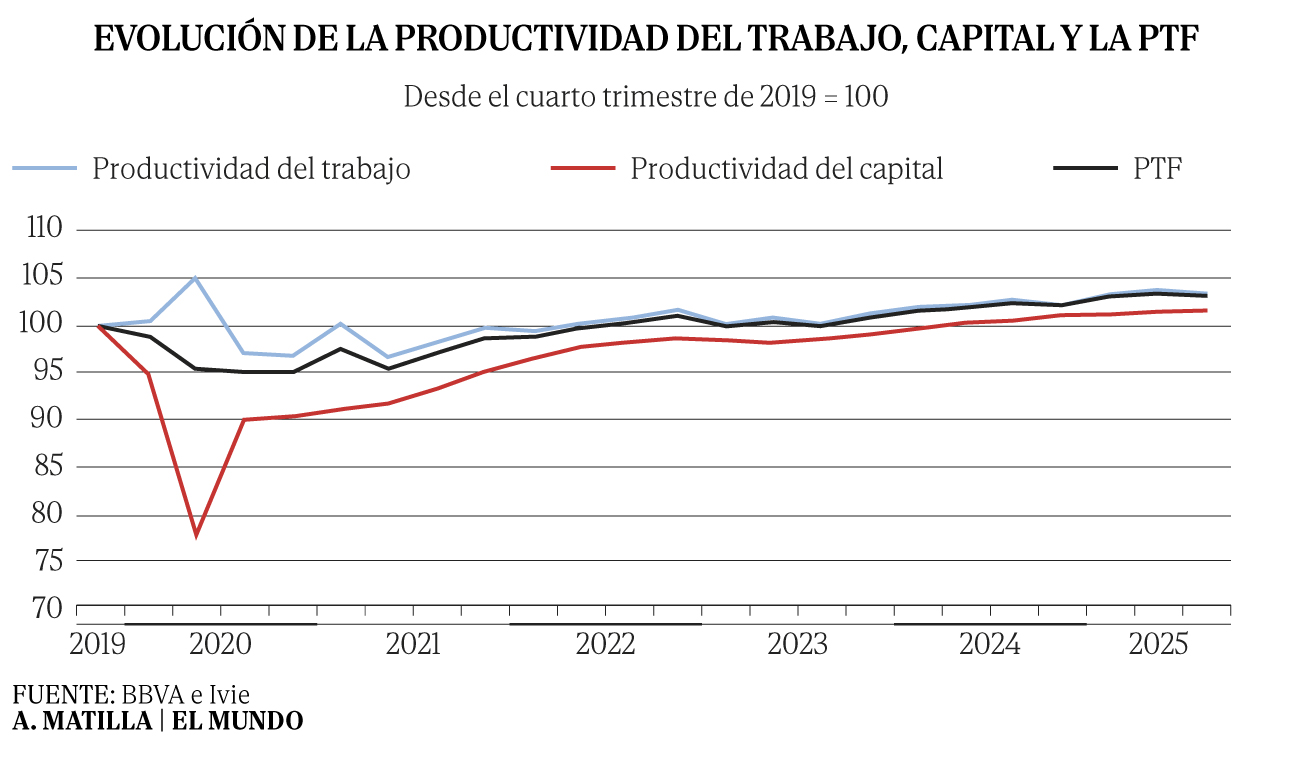
To critically understand the real backbone of this growth, one must examine the shifts in productivity. From 2019 to 2025, real productivity actually decreased by 1.7%. Meanwhile, employment expanded significantly—by 4.5% in the employment rate and 7.3% in the working-age population. This juxtaposition indicates that a considerable part of the GDP growth stemmed from a sheer increase in the workforce rather than enhanced productivity per worker.
Immigration’s Impact on Labor Growth
A prominent factor contributing to this increased workforce is immigration. The foreign working-age population surged from 4.3 million to 6.1 million, marking a 40% rise and significantly outpacing the mere 3% growth of the domestic population. This demographic shift is critical; without this influx, spanning a variety of sectors, real GDP growth would likely have stagnated.
Deconstructing Labor Productivity Metrics
While adding more workers to the economy, the productivity per employee offers a mixed message. In fact, individual GDP contribution per employed person fell from 15,907 euros to 15,641 euros between 2019 and the present. This trend underscores a concerning reality: while the employment figures rose noticeably, the quality of output per worker lagged behind.
Total Factor Productivity: A Deeper Dive
Economists often turn to Total Factor Productivity (TFP) for a clearer lens on efficiency. TFP reflects progress that cannot be linked solely to labor or capital growth, pointing to technological and organizational advancements. The latest data from the BBVA Foundation and Ivie reveals a TFP growth of 3.3% from late 2019 to 2025, suggesting that efficiency improvements may exist, contrasted with the apparent drops in productivity when measured solely per employee.
Conclusion: The Bigger Picture of Economic Growth
Choices in measuring productivity highlight differing perspectives. Productivity per employee indicates a drop, while productivity per hour worked shows slight improvements. Overall, Spain’s recent economic growth story underscores a reliance on expanding the labor market rather than rapid advancements in productivity or technological innovation, suggesting a persistent demand for strategic investments in higher-value sectors to ensure sustainable economic growth going forward.
This growth trajectory emphasizes that while quantity may have increased, a more robust economic future hinges on elevating the quality and efficiency of labor within Spain’s burgeoning workforce.