
“Bueno, señores, la sentencia”: A Historic Verdict Against Military Dictatorship Leaders
Historical Context
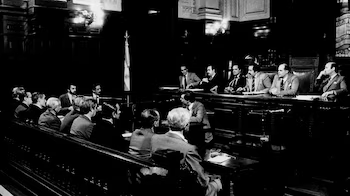
On December 9, 1985, a landmark moment unfolded in Argentina’s history. The Federal Court’s President, León Arslanián, adorned in a dark suit and a striped tie, opened the session to read the verdict concerning the nine leaders of the military juntas responsible for the country’s notorious “Proceso de Reorganización Nacional.” This military dictatorship, which ran from 1976 to 1983, was responsible for unspeakable atrocities, including forced disappearances and terrorism against its own citizens.
The Trial and its Impact
The trial marked a pivotal transition towards accountability. Initiated on April 22 of the same year, it took four months to gather testimonies from over 700 witnesses. Many had experienced the terror firsthand or were seeking clarity about the fate of the desaparecidos, individuals who had vanished during the regime. The courtroom echoed with horrifying accounts of torture and human rights violations, painting a grim picture of state terror.
Verdicts Delivered
As Arslanián read through the verdict—a moment that would later be endorsed by the Supreme Court—five of the nine military leaders received sentences. General Jorge Videla and Admiral Emilio Massera were each sentenced to life imprisonment. Other leaders faced less severe punishments: four and a half years for Brigadier Orlando Agosti, seventeen years for General Roberto Viola, and eight years for Admiral Armando Lambruschini. Controversially, several prominent figures, including Leopoldo Galtieri, walked free.
Mixed Reactions
While the verdict was historic, it led to a palpable sense of disappointment. Many observers, including journalists and attendees, expected harsher sentences. A collective murmur of discontent filled the packed courtroom as lighter sentences were announced, altering the anticipated jubilation to a somber reality. The historical implications of the trial weren’t fully acknowledged that day, nor did it settle the deeper societal fractures regarding accountability and justice.
The Legal Landscape
Alfonsín’s administration took a courageous step by prosecuting the military leaders, believing that embarking on a democratic path necessitated confronting the historical injustices of dictatorship. However, as the proceedings drew closer to the verdict, tensions escalated, with increasing threats from remnants of military power. The trial’s outcome set off a chain of events, leading to protests and political unrest, culminating in the 1987 Semana Santa rebellions, which challenged the government’s authority.
A Continuing Legacy
The trial has since become a symbol of Argentina’s effort to reconcile its past. The final point of the sentence called for the prosecution of other military officials involved in human rights violations, paving the way for future legal actions. Notably, the court established a precedent that underscored the systematic nature of the state violence inflicted during the dictatorship, emphasizing that no amount of legal justification could excuse the atrocities committed.
Reflection on Justice
While the 1985 trial represented a significant historical moment, it illuminated the complexities of justice in a fragile democracy. It served as a fleeting yet radiant moment when Argentina seemed poised for redemption from its dark past. Four decades later, the echoes of that day continue to resonate, reminding us of the ongoing struggle for truth and justice in the face of oppressive histories.
Conclusion
The December 9 verdict remains a foundational event in Argentina’s journey toward healing and justice. As officials today consider the narratives surrounding past atrocities, the insights gleaned from that historic day still illuminate discussions about accountability, memory, and the future of human rights.