
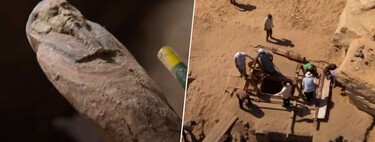
Unveiling the Hidden Secrets of the Pyramids of Giza
Talking about the pyramids of Egypt is synonymous with the Great Pyramid of Giza. Known as the most colossal, best-preserved, and oldest of the seven wonders of the ancient world, the Great Pyramid stands along with its companions, the pyramids of Khafre and Mycerinos (or Menkaura). Despite being the smallest of the trio, Mycerinos has long been thought to hold minimal secrets—until recent developments suggested otherwise.
The Surprising Hypothesis
It may seem implausible that some of humanity’s most studied monuments could still retain secrets. However, the ancient Egyptians’ monumental architecture continues to astonish us. Recent advances in exploration technology have led to renewed interest in these iconic structures. Archaeologist Stijn van den Hoven posited in 2019 that Mycerinos, initially believed to have a single entrance, could in fact possess an additional entryway due to some polished stones found on its northern side.
A Collaborative Investigation
To investigate this intriguing hypothesis, an international team from Cairo University and the Technical University of Munich began employing non-destructive measurement techniques. This is part of the ScanPyramids project, aimed at analyzing pyramids without causing damage. Their methods, already successful in revealing secrets of other historical sites, include:
Electrical Resistivity Tomography (ERT): This technique detects subsurface variations to reveal cavities or differing densities through electrode measurements.
Ground Penetrating Radar (GPR): Utilizing electromagnetic waves, GPR identifies anomalies by reflecting off various materials.
Ultrasound Testing (UST): This method examines sound wave reflections to provide insights into the internal structure without causing harm.
Air-Filled Anomalies Behind Mycerinos
The scans have led to the identification of two air-filled cavities located directly behind the polished granite blocks noted by van den Hoven. The details of these anomalies are enlightening:
Anomaly 1: Positioned 1.4 meters beneath the eastern surface, measuring approximately 1.5 meters wide by 1 meter high.
Anomaly 2: Situated 1.13 meters deep, with dimensions of about 0.9 meters by 0.7 meters.
The Implications of Discovery
Christian Grosse from the Technical University of Munich asserts that the use of these advanced techniques offers “very precise conclusions” regarding the pyramid’s interior. The identification of these air-filled cavities adds significant weight to the hypothesis of an additional entrance.
While many researchers agree that pyramid entrances are conventionally found on the north face, further exploration is needed to confirm whether these cavities indicate a new passage or serve another purpose altogether. Tools like infrared thermography or muon tomography with cosmic rays might offer deeper insights into the structure.
Cultural and Historical Significance
All exploration efforts are conducted under the supervision of the Supreme Council of Antiquities of Egypt and the Ministry of Tourism and Antiquities. This oversight ensures that significant discoveries can promote tourism while adhering to strict heritage preservation standards.
As technologies advance, new archaeological findings push the boundaries of what we know about these ancient structures. When the mysteries of Mycerinos are eventually unraveled, they have the potential to redefine our understanding of Egyptian pyramid architecture from 4,000 years ago.
Images | ScienceDirect, TUM