
The Rise of Robotic Tennis Players
Kasparov succumbed to Deep Blue, marking the dawn of a new era where machines could surpass human intelligence. From chess to Go and even StarCraft, AI has showcased its prowess in strategic games, primarily through sophisticated algorithms. Today, however, the battleground is shifting to sports, with researchers developing robots that are now aspiring to conquer tennis—an endeavor that presents unique challenges.
Introducing the LATENT Project
Be careful, Alcaraz, the robots are coming! Researchers from Tsinghua University and Peking University have embarked on an ambitious project named LATENT (Learn Athletic humanoid TEnnis skills from imperfect human Motion daTa). This innovative initiative draws parallels with developments like AlphaZero, where machines learn through autonomous play. Unlike earlier applications that focused on games with fewer physical complexities, LATENT aims to imbue robots with the skillset necessary for tennis—a sprawling and dynamic sport.
Imperfect Movements: A Breakthrough
Previously, programming a robot to respond at the speed of a flying tennis ball was daunting due to limited perfect movement data. The groundbreaking research here utilizes “imperfect” human movement data, captured from real players, allowing the robot to glean essential skills even from suboptimal performances.
Mini Tennis as a Training Ground
Obtaining precise data in a full-scale tennis match is a resource-intensive endeavor. To streamline this, the LATENT team focused on collecting “primitive skills” data, demonstrating basic movements like forehands, backhands, and lateral shifts. By confining their efforts to a court area 17 times smaller than a professional one, they significantly reduced complexity, enabling the robot to develop its unique technique more effectively.
Learning from Mistakes
What sets this development apart is the robot’s capability to adapt in real-time. By processing minimal data, it can make instantaneous corrections during movement, stability, and racket angle adjustments. This ability to learn dynamically mirrors human adaptability and will likely prove invaluable as technology continues to advance.
Innovative Reinforcement Learning
No strange things. Key to this project was the researchers’ desire to prevent the robot from developing bizarre movements during its training. To achieve this, they devised a technique that restricted the AI’s exploration to human-like motions, anchoring its development in reality.
The Unitree G1 Takes the Court
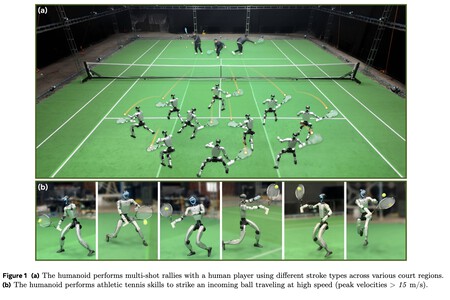
The culmination of this research is embodied in the Unitree G1 robot, which consists of 29 degrees of freedom. Equipped with a specially designed racket, it has demonstrated impressive physical capabilities—returning balls at speeds exceeding 15 m/s (54 km/h) and engaging in rallies with human players on a tennis court. Its ability to navigate the court and maintain composure in dynamic scenarios showcases the potential of robotics in sports.
The Future of Robotics in Sports
While these tennis robots remain far from rivaling human expertise—especially among professionals—they highlight a promising trajectory in applying reinforcement learning techniques previously successful in board games. The implications extend beyond tennis, offering a framework for robots to potentially learn any physical discipline from limited data inputs.
As robotics continues to evolve, one can’t help but wonder: what will be the next frontier?