
The Surprising Truth About Neanderthal Dentistry
Going to the dentist or having maxillofacial surgery may seem like modern concepts tied to our advanced intellect, but recent discoveries indicate that Neanderthals also engaged in dental care. New findings reveal that these prehistoric humans had rudimentary techniques for treating dental issues.
An Evolution in Understanding
Previously, it was thought that Neanderthals only used small wooden sticks to clean food remnants from their teeth—a method still employed by some modern primates. However, archaeological evidence from the icy mountains of Siberia has radically changed our understanding of Neanderthal healthcare. This new data suggests that they employed stone tools to perform invasive dental procedures, much like contemporary dental treatments, albeit with the limitations of their era.
The Case of ‘Chagyrskaya 64’
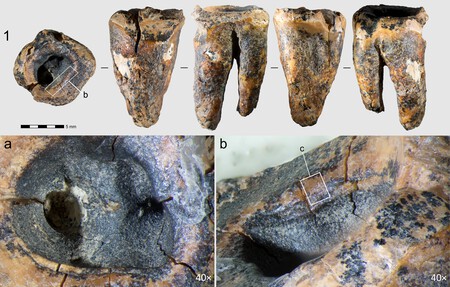
The focal point of this revelation is a tooth known as ‘Chagyrskaya 64.’ It belonged to an adult Neanderthal who lived in the Chagyrskaya cave within Russia’s Altai massif. This tooth provides crucial insights into the dental practices of one of the easternmost known Neanderthal populations.
Image via: PLOS. Tooth analyzed by researchers.
Analyzing the Tooth
At a cursory glance, Chagyrskaya 64 presented a massive cavity on its chewing surface. Initially, archaeologists attributed this feature to wear from hard foods or an accidental impact. However, closer inspection revealed smooth, rounded edges of the cavity, which dismissed the theory of accidental damage. Furthermore, the tooth’s pulp chamber showed widening indicative of deliberate intervention rather than mere wear.
What Really Happened?
Further analysis uncovered evidence that the tooth had a severe cavity, which someone attempted to treat by excising the affected area. The intense pain associated with such a large cavity likely prompted this early form of dental intervention.
Rustic Dentistry Confirmed
To validate the intentional nature of this dental work, researchers used micro-computed tomography alongside traceological analysis. This scrutiny unveiled V-shaped stepped microgrooves in the cavity’s walls, consistent with those made by a sharp stone tool commonly used during the Neanderthal era. Experimental archaeology further confirmed these findings by replicating the drilling process on modern human molars, producing the same markings.
Continuing Life After Dental Care
Interestingly, evidence suggests that the individual who underwent this form of dental intervention not only survived but also continued to chew using the tooth, as indicated by subsequent signs of wear and polishing. While they lacked modern restorative techniques such as fillings, this did not impede their daily life.

Image of early antiseptic: birch tar, a discovery of Neanderthals.
A Cognitive Leap
This knowledge showcases the complexity of Neanderthal cognition. Managing such an invasive dental procedure required considerable logical reasoning—recognizing the source of pain, devising a solution, selecting the appropriate tool, and executing precise movements. Such reasoning abilities distinguish Neanderthals from mere animals, highlighting their advanced mental capabilities.
Conclusion
The findings surrounding Chagyrskaya 64 challenge our assumptions about Neanderthal capabilities. Far from being rudimentary beings, they possessed a level of sophistication in healthcare that reshapes our understanding of their lives. As more evidence emerges, we continue to uncover the richness of the Neanderthal legacy.
Images courtesy of: Gerd Altmann, wavebreakmedia_micro