

In recent years, the fascination with body modifications has surged, pushing boundaries with innovations like chip implants under the skin, aimed at integrating human functions within the realm of smart homes . However, humanity has a long history of aesthetic modification, dating back over 5,000 years with tattoos found on Ötzi the Iceman. From non-invasive techniques to more extreme measures such as the Padaung women who elongate their necks with rings, our desire for physical alteration is nothing new. A recent discovery near Iran , however, offers a striking glimpse into the past: a 6,200-year-old skull belonging to a woman exhibiting an elongated shape, often referred to as a cone-shaped skull .
Sadly, her story did not end well.
Located in Chega Sofla , in western Iran, this archaeological site has been the focus of research for years. Investigators have been excavating bodies, uncovering numerous graves, from isolated burials to family plots. What’s particularly eye-catching is that some remains indicate that certain individuals exhibited cranial shapes significantly longer than average— not due to any natural deformation but rather for aesthetic purposes. Among these, a skull identified as BG1.12 captured archaeologists’ attention, revealing signs of a violent blow that led to her untimely death. What prompts further curiosity is not just how she met her end, but why she was buried there in the first place.
- Chega Sofla
- A region of rich archaeological material
- Investigations have revealed both individual and family tombs
- Rich history of human modification through different cultures
Cone-shaped skull. The young woman known as BG1.12 met her demise, possibly from a forceful blow to the head . Before this tragic event, she was likely just one among many, as this type of cranial modification was somewhat common in ancient civilizations. The practice involved tightly wrapping the heads of infants with bandages, gradually tightened as the child grew. This technique, akin to using a splint, continued into adulthood, leading to an elongated head shape, reminiscent of a cone. Though more prevalent among girls than boys, it’s evident that this ancient trend was not without its risks.
Dangerous. The notable injury on BG1.12’s skull led archaeologists to delve deeper into the cranial development of these ancient people. It was discovered that due to the tight wrappings, both the bones and the diploe—a more porous bone layer between the two denser layers of the skull—were thinner than typical. This anatomical differentiation undoubtedly compromised the skull’s protective function for the brain; therefore, when external stress was applied, this “brain shield” was less effective. At some point during her twenties, a forceful incident fractured this fragile skull, resulting in her death.
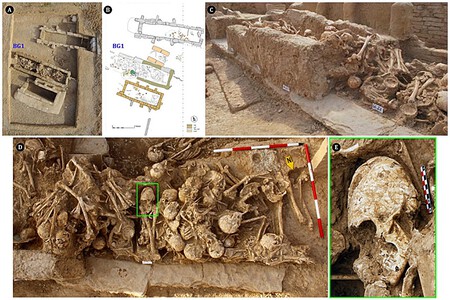
Researchers stated that even individuals with typically developed skulls could have succumbed to similar forces. They remain uncertain if she suffered an attack or if the incident was accidental. However, it’s confirmed that she was buried in a communal grave alongside individuals with both normal and modified skulls.
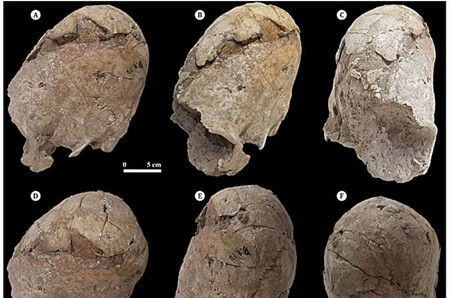
The skull of BG1.12 showing the injury
The role of women. Although it seems the injury was deadly even for those with normal cranial shapes, the enigma lies in deciphering the societal role of individuals with modified skulls. We’ve encountered similarly modified skulls across various cultures: from ancient Europe to Japan and Mesoamerica . The motivations behind these modifications vary, ranging from displaying status to achieving differentiation from neighboring groups or even attempting to emulate the appearance of deities. There are suggestions that aesthetics also played a significant role.
The mystery surrounding BG1.12’s burial beside individuals with varying cranial configurations complicates the task of deciphering her societal role in ancient contexts. With all skeletons tightly adhered, it’s challenging to identify individuals or deduce the roles played by these modified skulls in their communities.
Ultimately, the takeaway from BG1.12’s story serves as a cautionary tale. A simple stumble or an impact to a vulnerable head, along with a compromised diploe… and the result could be tragic. Even modern advancements, such as subjecting a head to extreme conditions like those in a particle accelerator, would not afford any advantages. The risks tied to such extreme modifications highlight a universal truth: sometimes, less is more .
Images courtesy of Cambridge.
In other news, a cave has revealed the macabre Maya ceremony to honor their gods, containing 100 bones , all found scattered in unusual places.