
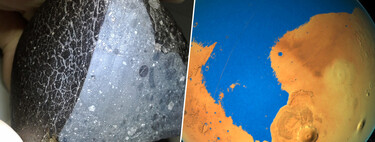
When the OSIRIS-REx mission capsule landed in the Utah desert in September 2023, NASA knew it had a treasure on its hands. We are talking about a bit of black dust that was collected millions of kilometers from Earth and that was about to rewrite one of the most important chapters in science: the origin of life.
The Traditional Understanding of Life’s Origins
What we knew. Until now, the predominant theory regarding the origin of life insisted that a hot chemical soup was essential for the creation of life’s basic components, such as amino acids. This “soup” required heat and liquid water for molecular interactions to spark. However, recent discoveries have flipped this long-standing perspective on its head.
The findings indicate that the building blocks of life can form not only in heat but also in the extreme cold and under gamma radiation, drastically altering our comprehension of how life could have emerged, not just on Earth but potentially across the universe.
Bennu: A Key Player in Astrobiology
The importance of Bennu. Bennu, a roughly 500-meter-diameter asteroid, is a significant fossil from the early solar system. Estimated to be around 4.6 billion years old, it is as ancient as the Earth but has remained largely unchanged by geological processes. This preservation makes it a prime candidate for studying the origins of life.
Surprising Discoveries from Bennu
As we delve deeper into the samples brought back by OSIRIS-REx, initial analyses have yielded a surprising abundance of essential elements like carbon, nitrogen, and organic compounds. Researchers at Penn State University have uncovered new insights that challenge traditional theories.
The surprise. While examining the isotopic composition of amino acids, particularly glycine, scientists detected a chemical signature that contradicted the classical theory of formation in warm water.
Revising the Formation Theory
A radioactive freezer. Previously, it was assumed that amino acids in asteroids were primarily formed through aqueous alterations, where heat melted ice and allowed for interactions with rock. However, new studies suggest that liquid water is not a necessity. Amino acids can be synthesized from simple ice, aided by gamma radiation from radioactive materials in the early solar system.
This transformative perspective explains how amino acids are found not only in asteroids that have undergone extensive heating but also in those that are ‘drier’ and colder, indicating that life could emerge in some of the harshest environments imaginable.
The Rich Chemical Landscape of Bennu
An increasingly complex menu. Studies have not only identified simple molecules but have also detected tryptophan, an essential and structurally complex amino acid vital for life on Earth. Moreover, components of DNA and RNA, along with ammonia and amines, have been discovered, surpassing the richness of notable meteorite samples, such as the Murchison meteorite.
Implications for Panspermia Theory
Backlash to Panspermia. The capacity for amino acids to form in irradiated ice grains in the solar nebula means these primary ingredients are likely scattered throughout the solar system.
Bennu’s wealth of organic compounds supports the idea that Earth may not have had to generate all the components necessary for life. A steady influx of asteroids during the late heavy bombardment could have provided a “biological starter kit” from space, reinforcing the notion that our cosmic heritage is deeply intertwined with celestial bodies like Bennu.
In essence, examining a grain of Bennu dust allows us to peek into our own chemical ancestry, revealing connections to the distant past that shaped life as we know it today.