
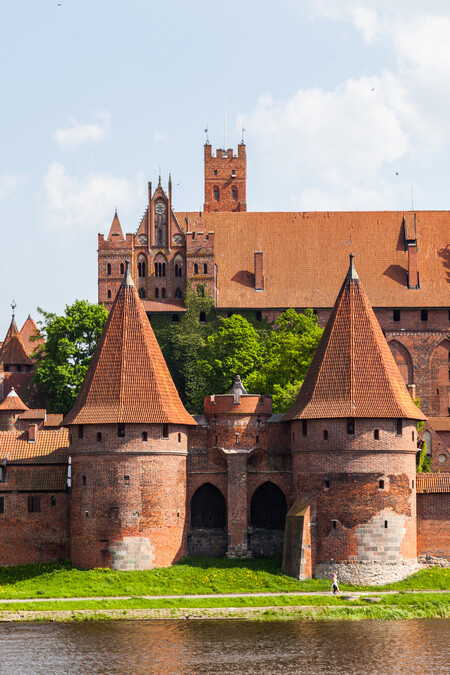
The Enigmatic Teutonic Order Castle in Malbork
Europe is replete with magnificent castles, but none quite match the grandeur of the Teutonic Order’s castle in Malbork. Erected in the 13th century, this stunning Gothic brick complex is not only a marvel of architecture but also holds the title of the largest castle in the world by surface area. To put its size in perspective, it is approximately four times larger than Windsor Castle, and it is recognized as a UNESCO World Heritage Site.
Architectural Marvel: A Masterpiece of Design
The Malbork Castle, located on the southeastern bank of the Nogat River in northern Poland, is not just significant for its size but also for its architectural brilliance. Known as the Ordensburg Marienburg complex, it includes a massive palace, a monastery, three separate castles, and hundreds of auxiliary buildings. These structures are separated by moats and towers, forming what is essentially three castles within one.
Construction began around 1274 and reached its pinnacle around 1406, taking just over 130 years to complete. The castle required approximately 30 million bricks for its construction, marking it as the largest fortified Gothic building in Europe. Inside, the castle showcased numerous innovations for its time, including hot air central heating and advanced sewage systems. The immense halls boast ribbed vaults, which are gothic engineering masterpieces.

Entrance. Diego Delso
Historical Significance: The Why Behind the Construction
The construction of Malbork Castle was intimately tied to the history of the Teutonic Order, a militarized Catholic religious organization that aimed to Christianize the Baltic region. Following their withdrawal from the Holy Land, they sought a new headquarters. In 1309, Grand Master Siegfried von Feuchtwangen transferred the Order’s seat from Venice to Malbork. This strategical move aimed at reinforcing control over the area after the Great Prussian Revolt of 1274.
With its strategic location along the Nogat River, Malbork became the nerve center of a Monastic State governing much of the Baltic. The castle played a pivotal role in establishing a monopoly on amber trade, allowing the Knights to collect tolls from ships and finance military campaigns against pagan communities in Lithuania while integrating into the Hanseatic League.
The Baltic Crusades: A Period of Military Might
Malbork reached its zenith during the Baltic Crusades, a time when Germanic military orders pursued forced Christianization of northeastern nations. Here, the castle wasn’t merely a defensive stronghold but served as a striking symbol of power, showcasing the might of the Teutonic Order.
Decline and Resurgence: From Ruin to Restoration
The decline of the Teutonic Knights culminated in their defeat at the Battle of Grunwald on July 15, 1410. The castle transitioned into Polish ownership in 1457 and remained a royal residence until 1772. However, the most devastating chapter of its history occurred during World War II, when the structure was reduced to ruins.
Commencing restoration in 1947, experts have meticulously worked to revive the castle, using historical documentation for guidance. Today, it houses the Malbork Castle Museum and was declared a UNESCO World Heritage Site in 1997, standing as a testament to resilience and historical significance.