
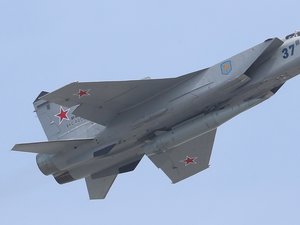
The ongoing conflict in Ukraine has taken a dramatic turn with the Russian Federal Security Service (FSB) announcing that it has thwarted a plot allegedly orchestrated by Ukraine and Britain. This claimed scheme involves attempts to hijack a MiG-31 fighter jet, equipped with the hypersonic Kinzhal missile, with an enticing reward of $3 million offered to Russian pilots for their cooperation. Moscow has characterized this as a significant “provocation” amid escalating tensions.
### The Allegations: A Closer Look
The FSB’s announcement, relayed through Russian state media, details a scenario where Russian pilots were to be lured into stealing the MiG-31 and transporting it to a NATO base in Constanta, Romania. Once there, it is claimed that the plane would be shot down by Western air defense systems, thus framing the incident as a coordinated act of aggression against Russia.
This narrative raises critical questions regarding the authenticity of the allegations. The FSB has not provided concrete evidence to support its claims, leading to skepticism among international observers. The report does not offer any independent verification, leaving many to wonder whether this is an attempt by Moscow to distract from its own military shortcomings.
### Context of Growing Tensions
Russia has long accused Britain of being one of its primary adversaries, citing the UK’s extensive support for Ukraine since the onset of the conflict in February 2022. Moscow’s rhetoric has intensified, portraying Britain as a collaborator in planning operations that directly undermine Russian security. The recurring theme in these accusations is the notion that Western nations are instigating conflict rather than pursuing diplomatic solutions.
As the war continues, the psychological and informational warfare tactics employed by both sides grow increasingly sophisticated. The Kremlin’s narrative surrounding this supposed hijacking plot fits into a broader strategy of painting Western powers as aggressors.
### The Role of the Kinzhal Missile
One of the focal points of the FSB’s claims is the Kinzhal missile, characterized as hypersonic. This missile is designed to travel at speeds that make it challenging for defense systems to intercept. Russia leverages the Kinzhal’s advanced capabilities to justify its military posture and actions, emphasizing the need for heightened vigilance against perceived Western threats.
Moreover, the emphasis on the Kinzhal missile underscores Russia’s intent to project strength and technological superiority amidst ongoing conflicts. The weapon has been highlighted in various capacities, reinforcing its presence within military narratives both domestically and internationally.
### International Response and Media Skepticism
Globally, the response to the FSB’s claims has been one of skepticism. Major news outlets, including Reuters, have noted the lack of independent verification and have raised concerns about the potential for manipulation of information in a time of war. The media landscape is rife with disinformation, making it crucial for analysts and the public to scrutinize reports carefully.
As both Ukraine and its allies continue to denounce Russian aggression, the risk of misinformation becoming a tool for political maneuvering remains high. The implications of these claims, whether true or fabricated, could have significant repercussions for diplomatic relations and military strategies in the region.
### Conclusion
The FSB’s assertions regarding a Ukrainian-British plot to hijack a MiG-31 fighter jet are emblematic of the current state of the Ukraine conflict—where allegations, counterclaims, and geopolitical narratives intertwine. With the stakes higher than ever, the international community must tread carefully, prioritizing transparency and verification to navigate through an increasingly complex battlefield of information.