
On Tuesday, October 7, the former Lithuanian Prime Minister announced that Russia would consider an attack on NATO. Faced with this threat, the alliance is preparing its anti-drone wall.
A new turning point in the War in Ukraine has emerged. The former Lithuanian Prime Minister, now serving as the European Defense Commissioner , Andrius Kubilius, issued a stark warning on October 7. He alerted NATO members to a probable Russian offensive , as reported by TF1.
Kubilius emphasized, “I trust the intelligence services. And the German services claim to have proof that the Kremlin is considering an attack on NATO,” according to reports from Polish newspaper Wyborcza.
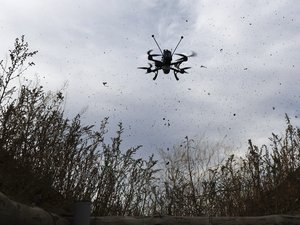
The concerns aren’t unfounded; an upsurge in Russian drone flights over European skies has prompted authorities to take action. To counter these aerial threats, NATO has already mobilized fighter jets and missiles , with operational costs nearing €700,000 according to TF1.
Towards an Anti-Aircraft Front Line at the Gates of Europe?
In light of this escalating threat, NATO is exploring the development of an anti-drone wall . This strategic initiative would span from Finland to Ukraine , resembling an electronic barrier equipped with antennas capable of detecting the sound of incoming drones. Once detected, ground-based anti-aircraft systems would jam the signals of these rogue drones. As a last resort, European drones could potentially engage and attack those operated by the Kremlin.
In addition to traditional measures, NATO is considering an innovative solution: robotic machine gunners enhanced by artificial intelligence. This cutting-edge technology could autonomously target and neutralize enemy drones, providing an additional layer of defense. However, the feasibility of these initiatives remains under scrutiny, primarily due to the significant financial implications involved. Creating an anti-drone wall could be prohibitively expensive and might not yield effectiveness for at least six months , raising vital questions about Europe’s financial capabilities, as ongoing debates indicate.
The geopolitical landscape in Europe is rapidly shifting, and the implications of these developments are profound. A cohesive and effective NATO response is more crucial than ever in addressing the threat posed by Russia. As the military and diplomatic strategies evolve, there is a growing recognition that unity among NATO allies is paramount to ensure regional stability and security.
The specter of conflict looms large, and proactive measures are necessary to deter any potential aggression from the Kremlin. Leaders are faced with the urgent task of fortifying defenses while simultaneously anticipating the next moves of Russian President Vladimir Putin . The commitment to strengthen NATO’s defensive capabilities is critical, not only to safeguard against immediate threats but also to reassure member states of their collective security obligations.
As drone warfare becomes an increasingly potent tool in modern military engagements, NATO’s focus on an anti-drone strategy signals a significant pivot in its operational priorities. The growing reliance on advanced technologies underpins the alliance’s strategic recalibrations, shaping the future of European defense in an era headlined by unpredictable geopolitical tensions .
The discourse surrounding these developments is multifaceted and nuanced. Economically, NATO member states must strike a balance between immediate defense needs and long-term financial sustainability. Diplomatically, fostering stronger alliances within the bloc and beyond will be crucial to ensure an effective and coordinated response against potential threats. The dialogue between member nations will play a vital role in crafting a united front capable of handling the evolving security landscape.
In the face of uncertainty, the necessity for unified action becomes clearer. With increasing threats on the horizon, NATO’s ultimate goal remains to protect its allies and maintain stability throughout Europe. The warnings from Kubilius serve as a clarion call for action; it is imperative that the alliance remains vigilant and prepared to adapt to the challenges that lie ahead.