
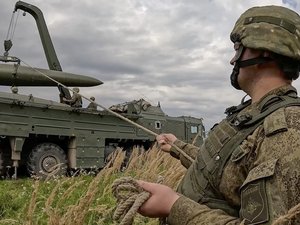
The interception rate of Russian missiles by the Ukrainian army has recently experienced a significant decline, dropping from 37% in July to a mere 6% by September. This alarming trend has raised concerns among military analysts and strategy developers both in Ukraine and internationally. As reported by *The Financial Times*, the reasoning behind this drastic decline can primarily be attributed to modifications in the trajectories of two notable missile types: the ISKANDER-M and the KINJAL . These changes have rendered interception increasingly challenging, especially for the advanced American Patriot missile defense systems.
This situation presents a worrisome development for the Ukrainian military. Throughout July, they successfully intercepted over a third of incoming Russian missile attacks, showcasing their defensive capabilities. However, as the conflict has continued, the rate of successful interceptions has sharply fallen. Interestingly, this drop coincides with a period of reduced Russian missile launches , which indicates that the effectiveness of Ukraine’s defensive technology is being compromised by new tactics employed by Russian military forces.
Understanding the Russian Modifications
The decline in interception rates has prompted many to seek an explanation rooted in the ongoing development of Russian military technology. According to multiple reports from both U.S. media and defense analysts, including insights shared by weapons expert Fabien Hoffmann , the recent modifications made to the ISKANDER-M and KINJAL missiles are key factors in Ukraine’s declining interception rates.
The ISKANDER-M is a tactical ballistic missile known for its precision and range of up to 500 kilometers , while the KINJAL is a hypersonic missile with a range of approximately 480 kilometers . These types of missiles are particularly alarming for their ability to navigate beyond typical defense systems. In restructuring their attack patterns, Russian missile systems are now capable of altering their trajectory mid-flight. This strategic shift complicates interception plans, as the Patriot systems , known for their reliability, become less effective when faced with sudden changes in missile course.
A Game Changer in Modern Warfare
The modifications to Russian missiles have been likened to a “game change” in modern warfare, indicating a significant shift in the dynamics of missile defense. Former Ukrainian officials have echoed this sentiment, emphasizing the substantial challenges posed to their military operations. The Russian President, Vladimir Putin , has previously dubbed the KINJAL as “invincible,” showcasing the confidence that Russia has in its evolving missile technology.
To further complicate matters, the strategies employed by the Ukrainian military in adapting to these evolving threats must be reassessed. Given that the number of Russian missile attacks has decreased, the emphasis on successfully intercepting incoming missiles still plays a critical role in national safety. The current landscape necessitates an urgent review and potential enhancement of existing defensive measures to counteract these newly engineered threats from Russia.
International Implications and Responses
The implications of this situation extend well beyond the Ukraine-Russia conflict. Allies and partners across the world are closely monitoring the developments, especially those who are reliant on similar missile defense systems. The modifications made by Russia raise questions regarding the effectiveness of existing military alliances and defense technologies in protecting allied nations from comparable threats.
As the conflict evolves, there is an increasing call for enhanced collaboration among NATO members and other allies to develop advanced counter-measure technologies. This could involve joint training exercises, sharing intelligence on the latest techniques, and investing in the research and development of next-generation defensive systems.
In summary, the drastic fall in Ukraine’s missile interception rates is a clear indication of the dynamic and rapidly evolving nature of modern warfare. With Russia’s advancements in missile technology and tactics, the Ukrainian military, supported by international allies, will need to adapt quickly to maintain their defensive capabilities and ensure the safety of their nation. This situation is a powerful reminder of the shifting landscapes of military strategy and the ongoing need for innovation in defense technologies. As global conditions continue to change, so too must the methods employed to protect nations from new threats in a constantly evolving battlefield.