
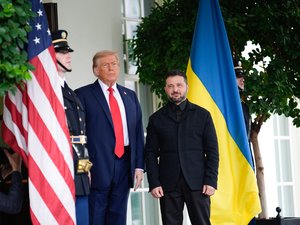
On Monday, August 18, in Washington, Donald Trump announced the initiation of preparations for a significant meeting between Volodymyr Zelensky , the President of Ukraine, and Vladimir Putin , the President of Russia. During this press event, Trump expressed his aspiration to provide security guarantees for Ukraine, amid ongoing challenges in peace discussions. Although no date or location has been confirmed, Hungary has surfaced as a possible venue for this critical summit.
During the extraordinary summit at the White House, Trump conveyed his commitment to assist in securing peace in Ukraine. He stated, “*Regarding security, there will be a lot of help,*” emphasizing the involvement of European leaders in this process. Accompanying Zelensky were key figures including French President Emmanuel Macron , British Prime Minister Keir Starmer , and German Chancellor Friedrich Merz . This meeting occurred shortly after a bilateral summit with Putin in Alaska .
Historically, Russia has consistently rejected the notion of deploying NATO troops in Ukraine, asserting its position through a recent statement from its Ministry of Foreign Affairs just ahead of the Washington discussions. The tone of the dialogues appeared to signify a stark contrast to Zelensky’s previous visit, which had sparked a notable confrontation in February.
“Important lines”
Zelensky expressed hope, calling this moment a “*Brand step forward*,” stating that formal security guarantees would be “*Formalized on paper within a week to ten days.*” Macron also highlighted “*Important lines*” activated during the discussions at the White House, in particular the security guarantees intended for Kyiv.
The French President noted that a “principle of a series of meetings” was agreed upon, beginning with a direct dialogue between Zelensky and Putin, and extending to a trilateral format that includes Trump. In an update on the discussions shared via his Truth Social platform, Trump communicated that preparations for a meeting between Zelensky and Putin were underway, with the objective suggested by Putin himself.
Hungary as a Meeting Place
Amidst the dialogues, a Trump administration representative mentioned Hungary as a potential location for the Putin-Zelensky meeting . Notably, Hungarian Prime Minister Viktor Orban has a rapport with the Russian president, although Moscow has not confirmed the meeting. Kremlin advisor Youri Ouchakov commented on the exploration of raising the level of representatives involved in future discussions, noting that the last negotiation cycle between Russia and Ukraine took place in Turkey last June.
The European attendees encouraged Trump to apply pressure on Putin to agree to a ceasefire , highlighting the necessity for a halt to hostilities before meaningful peace negotiations can proceed. “We cannot chat under the bombs,” Macron emphasized, underlining the urgency for increased pressure on Russia.
“It could be a disadvantage for a camp or the other”
During his Oval Office address, Trump expressed his support for the concept of a ceasefire but also acknowledged the ongoing conflict between Russia and Ukraine. “*I would like them to stop [the fighting]*,” he stated. “*But, strategically, it could be a disadvantage for a camp or the other.*” Kremlin envoy Kirill Dmitriev reflected on the day, describing it as significant for diplomacy that emphasizes lasting peace rather than a temporary ceasefire.
Zelensky’s recent White House visit was markedly different from previous interactions, where he often faced criticism from Trump’s administration for a perceived lack of gratitude. Upon arrival, he instead expressed appreciation towards the Trump administration for its support. Moreover, unlike his previous trip when he wore military attire, this time Zelensky donned a black suit, which was positively received by Trump.
Compromise on Both Sides
Trump aims to navigate the complex relationships between both countries by advocating for a compromise . Despite acknowledging the stark realities of the conflict, he urged Ukraine to reconsider its objectives, specifically concerning the recovery of Crimea—annexed by Russia in 2014. Trump’s assertion that “an exchange of territories for the good of both parties” could facilitate dialogue was firmly rejected by Zelensky, who emphasized Ukraine’s stance against yielding territory, particularly in the Donbass region that remains under dispute.
In this intricate geopolitical landscape, the unfolding dialogues are pivotal for nurturing a fragile peace. With leaders from multiple nations coming together, the prospect of resolving longstanding tensions remains a point of intense focus and discussion. The coming weeks will prove crucial as both sides navigate the complexities of diplomacy and the quest for a lasting resolution.