

Two recent events in the United States, occurring just days apart and within a few hundred kilometers of one another, collectively illustrate the escalating threats posed by poaching and the ongoing quest for technological superiority in the realm of military capabilities. Both incidents reveal a landscape shrouded in secrecy and manipulation, highlighting how these aspects intertwine within national security concerns.
An Enigmatic Accident. On September 23, 2025, a craft from the 432nd Wing of the United States Air Force crashed in the Nevada desert, not far from the legendary Area 51. The Air Force confirmed that there were no casualties or material damage, yet the subsequent reaction caught the attention of many: the FAA imposed temporary airspace restrictions , citing “national security.” Such actions are normally reserved for incidents involving sensitive materials and technologies.
The 432nd Wing, stationed at Creech Air Force Base, predominantly operates MQ-9 Reaper drones but also houses squadrons responsible for new-generation aircraft like the RQ-170 Sentinel . The official silence surrounding the specific model involved in the crash has led to rampant speculation that what transpired was more than an ordinary accident—perhaps it could be tied to a loss related to black advanced development programs .
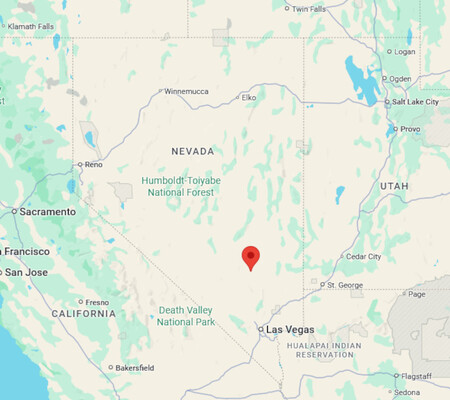
<span>Map showing the coordinates of the temporary airspace restrictions for “National Security” effective between September 23 and October 1.</span>Manipulation at the Site. Of considerable interest was the discovery of indications of manipulation at the crash site. After the cleaning and removal of remains, investigators uncovered an inert training device and an aircraft panel of unknown origin, seemingly placed after the crash. Both the Air Force and the FBI initiated a joint investigation to ascertain how these items appeared, despite the area being under surveillance until September 27.
Public admission of such alterations by authorities is highly unusual, compelling speculation that they relate to the protection of sensitive information . The notion that external components were introduced into a recently secured site raises questions about safety protocols and what was either concealed or inadvertently revealed.
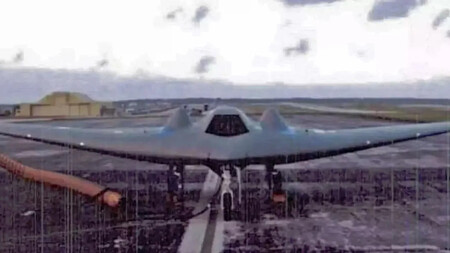
<span>The only official image of the RQ-170 published by the US Air Force, showing the drone at Andersen Air Base in Guam.</span>The Background of the Programs. Given its proximity to Area 51 and the involvement of a wing concentrated with both conventional and highly classified drones, the notion that the downed craft was merely a MQ-9 Reaper stands challenged. Such drones have experienced mishaps before, and the Air Force has typically reported these without significant disguise. Hence, it seems implausible that a routine incident warranted an airspace closure and FBI intervention.
Speculation arises that the incident might involve an experimental prototype related to advanced sensor technology or new poaching configurations, lending credence to the context of Area 51 and the stringent protocols surrounding its ultra-secret programs.
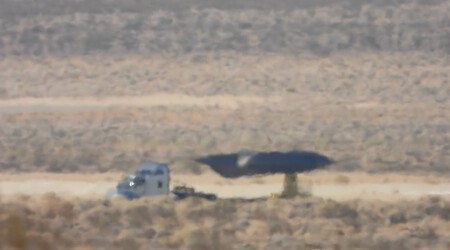
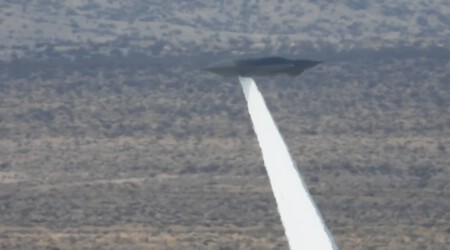
Another Strange Object. Concurrently, at the Lockheed Martin test center in Helendale, California, a dark object was captured on film—its shape resembling that of a rhomboid or a flying wing, mounted on a pylon during a radar test. Observers noted its surface bore bluish areas, diverging in dimensions from known aircraft. This sparked speculation as to whether it was a fuselage module , a partial design of future stealth aircraft, or possibly just a calibration tool.
For decades, Skunk Works has utilized this facility for validating materials and configurations aimed at minimizing radar detectability. Engineers often assemble inverted models to reduce undesirable reflections. The daylight testing indicated that this was unlikely to be a classified prototype, but rather part of the ongoing research that drives next-generation aerospace programs.
The Weight of Observation. Moreover, the Helendale images reignited discussions regarding the limits of observation from public lands and the precarious balance between civilian curiosity and operational security. The apparent permissiveness towards observer presence, along with sightings of an MQ-9 Reaper drone, suggests that the tests carried out did not involve particularly sensitive material.
Conversely, the obscurity concerning the Nevada incident illustrates how secrecy adapts contingent upon the stakes involved: an experimental object devoid of strategic value can be showcased in broad daylight, while the downfall of a craft linked to sensitive military programs necessitates stringent control over the narrative. Viewed holistically, both incidents underscore the United States Armed Forces and the defense industry’s efforts to navigate the delicate boundary between technological exposition and the safeguarding of sensitive advancements.
Two Pieces of the Same Puzzle. The temporal coincidence between the crash near Area 51 and the sighting of a mysterious object in Helendale strengthens the hypothesis that the U.S. is engaged in an accelerated cycle of stealth testing, potentially “hiding” its advanced developments. The contrast between the obscurity enveloping the Nevada incident and the relative transparency observed in California suggests that while a highly sensitive prototype was lost in one instance, the other was a routine technical test. Both events reflect a unified objective: the enhancement of next-generation stealth aircraft technologies capable of eluding radar detection.
Regardless of the specifics, the intertwined narratives of site manipulation, FBI involvement, and new forms observed at Skunk Works facilities collectively underscore the ongoing advancements in U.S. secret aviation. This scenario presents the public with fragmented glimpses of a technological evolution that could meaningfully impact the global military balance in the years to come.
Image | David James Henry, Uncanny Expeditions, Google Maps, USAF.