
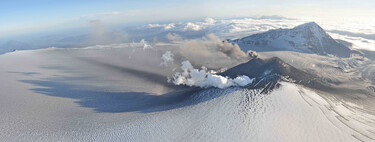
The Underwater Colossus: Enmedio Volcano
Under the Atlantic Ocean, approximately 80 kilometers southwest of Tenerife and Gran Canaria, lies the lesser-known Enmedio volcano. This underwater giant towers with a base of 3.5 kilometers, while its summit lies 1,625 meters beneath the waves. For years, this colossus has been relatively overlooked, but recent research by the CSIC (Consejo Superior de Investigaciones Científicas) has unveiled signs of hydrothermal activity for the first time, marking a significant discovery.
A Decade of Research
The journey to this revelation did not happen overnight. A dedicated team of geologists has spent nearly ten years gathering multidisciplinary data, primarily through the VULCANA project. The results of their extensive measurements, taken between 2015 and 2024, have now been published in the Bulletin of Volcanology. Through a series of oceanographic campaigns employing high-resolution bathymetry, seismic analysis, and geochemical studies, scientists have confirmed that Enmedio possesses an active circulatory system.
What Have Scientists Discovered?
Recent findings indicate that Enmedio exhibits low-temperature hydrothermal activity. The volcano is releasing mineral-rich fluids through fractures and depressions, hinting at tectonic activity beneath the surface. However, this does not imply that an eruption is imminent.
To better understand the situation, researchers analyzed the surrounding waters and detected thermal anomalies up to 0.5 ºC above normal levels. These elevated temperatures, combined with an enriched presence of nutrients like ammonium and iron oxide, suggest significant biological transformations occurring in the area’s geology.
Eruption Fears: A Clarification
The term “volcanic activity” often invokes images of explosive eruptions, particularly in the context of the Canary Islands. This anxiety is compounded by recent seismic swarms around the Teide volcano. Nonetheless, CSIC has provided a clear statement that the signs detected at Enmedio do not indicate an impending eruption, nor are they linked to the ongoing seismic activities nearby.
A Biodiversity Paradise
Hydrothermal vents, such as those found at Enmedio, are vital for deep-sea biodiversity. They act as chemical engines that contribute to the ocean’s composition and support unique communities of microorganisms that thrive under extreme conditions. In this light, learning more about Enmedio’s hydrothermal activity broadens our understanding of how such ecosystems flourish.
In retrospect, the Tagoro volcano’s eruption in 2011 provided valuable insights, as it helped nourish the local marine ecosystem after its explosive phase. Similarly, the fluids released from Enmedio are expected to have a positive impact on marine life.
A New Era in Volcanic Monitoring
While Enmedio was not a newfound discovery, this recent evidence of its hydrothermal activity ushers in a new phase for volcanic monitoring in Spain. The underwater wonders of the Canary Islands continue to serve as an invaluable natural laboratory, enhancing our scientific understanding of both volcanic and oceanic processes.
As researchers delve deeper, the underwater realm of the Enmedio volcano promises not only to shed light on geological phenomena but also to catalyze discussions surrounding marine conservation and ecosystem resilience.
Images sourced from the CSIC.