
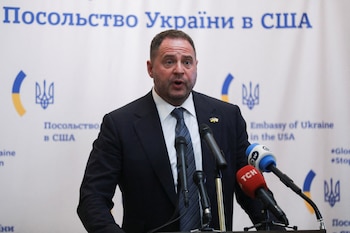
“The ultimatum that Trump has given Putin expires this week. Thousands of lives depend on the success of what comes later. The tools to stop Russia exist. What is needed is the political will to use them with precision and strength.” With this warning, Andriy Yermak, Head of the Presidential Office of Ukraine, summarized in The Washington Post the urgency to act before the war that Vladimir Putin waged against his country spirals out of control. The statement, located in the final stretch of its editorial, underscores the need for immediate and decisive measures from the international community.
Yermak’s analysis references a recent shift in position from Donald Trump, who has reportedly intensified his rhetoric against Russia. Trump stated, “We thought we had already solved it several times, and then President Putin goes out and begins to launch rockets against a city like Kyiv and kills many people in an elderly residence or whatever. And I say that this is not the way to do it.” For Kyiv, this affirmation represents a significant advancement. “We thank Trump for his firm and unequivocal commitment to peace through force. It is a commitment that we share,” Yermak said, emphasizing that Ukrainian resistance has been sustained on the premise: “The Ukrainian force is the only language that Putin understands.”
Furthermore, the Head of the Presidential Office of Ukraine warns that diplomatic and military pressure must be complemented with a more incisive economic strategy. “Russia’s military-industrial complex must be better attacked,” he asserts. He pointed to entities such as ROSATOM and ROSCOSMOS—Russian nuclear and space agencies—as crucial components in Putin’s war machine. “Rosatom sustains the development of nuclear weapons and facilitates the occupation of the Zaporiyia nuclear power plant. Roscosmos provides satellite images and communications that guide Russian missile attacks. Both agencies must be sanctioned in their entirety and prohibited from cooperating with Western scientific and academic institutions,” Yermak details in The Washington Post.
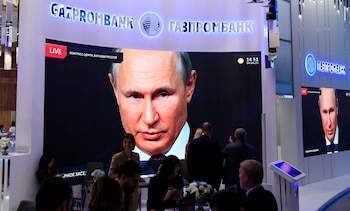
Access to Russia’s international finances presents another critical front. While disconnecting some Russian banks from the SWIFT system in 2022 was a milestone, Gazprombank continues to operate as the primary channel for sanctioned trade, especially in energy and defense goods. “Gazprombank must be disconnected along with any minor financial institution that tries to take its place,” Yermak insists.
The proposal goes beyond conventional sanctions, advocating for a total economic blockade. Russia imports billions in microchips and electronic components—critical for its drones and missiles—through China and countries in Central Asia. These products often contain Western origins and reach their final destination through indirect trade routes and legal loopholes. “We are very close to recent United States actions to stop the evasion of sanctions. The Graham-Blumenthal bill is a firm step towards the imposition of secondary sanctions to entities in third countries that finance Russian war machinery,” asserts Yermak.
The hardening of American tariffs against India for purchasing Russian oil above the capped price has also started to show effects. “It is a great first step, but more pressure is needed,” emphasizes Yermak. From the International Working Group on Sanctions to Russia that he co-chairs, specific proposals have been developed, including punishing Russian ports used to export oil, identifying operators of petroleum ghost fleets—ships that deactivate tracking systems to hide their origins—and pursuing intermediaries in the defense supply chain, including cryptocurrency infrastructure that facilitates sanction evasion.
For Yermak, the war waged by Russia against Ukraine represents a global threat. “When a fire burns with such ferocity, you have to act before the flames consume everything,” he warns, articulating a sense of urgency that resonates with the international community.