
The UK Takes Initiative Amid Rising Tensions
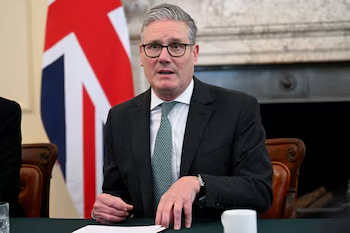
British Prime Minister Keir Starmer has reiterated his government’s stance amidst increasing tensions in the Middle East, stating that the situation involving the U.S. and Israel in Iran “is not our war.” This declaration comes despite significant pressure from former President Donald Trump, particularly in light of rising global energy prices.
To address these concerns, the UK is spearheading an international effort aimed at reopening the critically important Strait of Hormuz, a pivotal maritime route for the global supply of oil and natural gas. The Prime Minister has announced plans for a meeting in London with 35 nations interested in collaborating to ensure safe navigation for ships in the Gulf.
Upcoming International Meeting
In this meeting, which will be led by British Foreign Secretary Yvette Cooper, participants will evaluate various diplomatic and political measures to enhance maritime security. Starmer has emphasized a commitment to broader collaboration with European allies, indicating that discussions will extend beyond superficial assessments of previous agreements.
“This won’t just be a balance summit; we aim for a deeper collaboration, especially regarding economic issues,” Starmer noted, insisting on a thorough approach to future relations with the EU.
European Proposals for Maritime Security
Starmer’s call for an international coalition is not without precedent. French President Emmanuel Macron had previously proposed similar measures, particularly following recent Iranian attacks against British bases in Cyprus. Meanwhile, Kaja Kallas, EU High Representative, has suggested expanding existing naval operations—namely, the Aspides and Atalanta missions—to provide enhanced protection to shipping lanes in the region.
The Aspides mission was established in February 2024 to address maritime threats in the Red Sea, while Atalanta has evolved since its inception in 2008 from piracy prevention to tackling illicit trafficking at sea.
Challenges to International Cooperation
Despite these initiatives, not all European countries are onboard. Spain, for instance, has declined to participate in any military operations that could escalate tensions in the region. Nonetheless, the European Council recently approved updated objectives for both missions according to their resources and capabilities.
Pressure from the U.S. and a Staunch Response
As discussions unfold, the U.S. is ramping up pressure on its NATO allies regarding their involvement. The refusal of some nations like Spain and Italy to allow the use of their airspace and bases for American forces has created friction, with France also closing its airspace to U.S. military aircraft participating in the operation.
Former President Trump has publicly criticized the UK and other nations for their reluctance to engage more directly. However, Prime Minister Starmer remains resolute. “Despite the immense pressure to alter my position, I will not change my stance regarding military involvement,” he asserted firmly.
Conclusion
The UK’s initiative to form a coalition for maritime security in the Strait of Hormuz reflects a clear acknowledgment of the strategic importance of the region. As global energy prices fluctuate and tensions rise, collaborative diplomatic efforts will be essential for stabilizing the situation and ensuring safe passage for international shipping.