
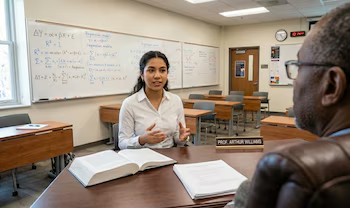
Emphasizing Oral Exams
A growing number of university educators across the United States are embracing oral exams to counteract the challenges posed by artificial intelligence in academic assessments. As concerns rise about how generative AI tools might hinder the development of critical thinking and creativity among students, educators are looking for alternative assessment methods.
Addressing the Impact of Technology
According to ABC News, this innovative shift away from electronic evaluations aims to directly verify learning. In a landscape where written assignments can appear flawless, many students struggle to articulate their own thoughts and ideas. This prevalent issue is prompting a revival of traditional assessment styles reminiscent of institutions such as Oxford and Cambridge.
Case Studies in Higher Education
For instance, Chris Schaffer, a professor of biomedical engineering at Cornell University, mandates that his 70 students defend their work through individual 20-minute oral sessions following the submission of written assignments. Schaffer emphasized that the goal is not merely to combat plagiarism but to stimulate deeper mental engagement. “It’s impossible to use AI in an oral defense,” he stated, underscoring the importance of personal accountability in learning.
Evolution of Assessment Methods
Since the surge of ChatGPT in 2022, this concern has escalated, prompting institutions like those in Pennsylvania and New York to launch workshops aimed at training educators on developing oral examination frameworks.
Panos Ipeirotis, from New York University’s Stern Business School, has even tested a cutting-edge variation: an oral exam featuring a voice agent created in collaboration with the startup ElevenLabs. Here, students engage with a non-human conversational partner, addressing real-time questions tailored to their responses, allowing for immediate feedback and insight into their genuine understanding of the material.
Diverse Student Reactions
While some students express discomfort, preferring the traditional written format, others acknowledge the benefits of oral assessments. For example, Olivia Piserchia, a biomedical engineering student at Cornell, noted that personal interaction can prepare students for real-world communication scenarios. Conversely, Andrea Liu, a business major at NYU, pointed out that while AI adaptation is complex, acknowledging its prevalence is essential for modern education.
Moving Forward: Embracing Change
This methodological evolution is not uniform across all institutions, as the US education system has historically leaned on written models. The need for adaptability is critical, especially in both the humanities and applied sciences, where students often overlook essential reasoning skills necessary for innovation and future employment.
Conclusion: The Future of Assessment
As educational landscapes shift, the prominence of oral evaluations, presentations, and interactive learning methods are becoming more prevalent. This trend reinforces direct communication between educators and students, enabling a deeper understanding of the subject matter being taught and fostering authentic learning experiences. Clay Shirky, NYU’s Associate Vice President for AI and Technology, emphasized the importance of direct eye contact to gauge comprehension, highlighting the need for accountability and engagement in today’s digital age.
Ultimately, the transition to oral assessments reflects a significant shift in educational paradigms, as universities seek to foster genuine learning and skills development at a time when technology is ever-encroaching.