
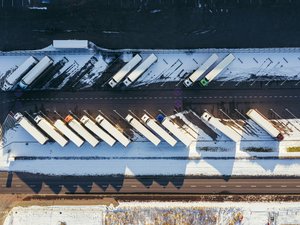
Two thousand trucks are stuck in Belarus after the border with Lithuania was closed. The drivers denounce a “hostage situation” following Vilnius’ decision to restrict traffic with Belarus, accused of smuggling contraband cigarettes through the air.
The Border Crisis Unfolds
As tensions escalate between Lithuania and Belarus , around two thousand trucks have found themselves trapped in Belarus due to the recent border closure. This bold move by Vilnius comes as a direct response to incidents involving balloons reportedly carrying contraband cigarettes entering Lithuanian airspace, which officials describe as a “hybrid attack” .
According to Oleg Tarasov, vice-president of the National Association of Road Transporters of Lithuania (Linava), “About 2,000 trucks are stuck in Belarus.” This situation has left many drivers feeling abandoned and anxious, as they declare themselves to be in an untenable “ hostage situation.” Tarasov notes, “The Belarusians have detained all Lithuanian vehicles and are not letting them leave the border area. We are hostages; our property is being taken hostage.”
This predicament has significant financial implications. Tarasov estimates that 60 million euros worth of assets are currently immobilized in Belarus, leading to an estimated loss of 18 million euros per month for the Lithuanian logistics sector.
Impact on Logistics and Employment
The logistics sector in Lithuania is vital to the country’s economy, employing around 54,000 drivers and operating 56,000 trucks . The closure has also affected many companies reliant on the smooth operation of goods transport across borders.
Despite expressing understanding for the border closure as a necessary precaution, Tarasov has criticized the Lithuanian government for failing to consult or warn truck drivers ahead of time. This lack of communication has added to the hardship faced by those in the logistics sector, turning an already difficult situation into a crisis.
Regional Tensions Escalate
The closure of the border between Belarus and Lithuania isn’t an isolated incident. In September, neighboring Poland temporarily closed its border with Belarus while conducting joint military exercises with Russia. Although Poland later reopened part of its border, the series of closures underscores the increasing friction in the region, which has been exacerbated by Russia’s invasion of Ukraine.
As of now, Lithuania has kept two border crossing points with Belarus operational—Salcininkai and Medininkai—however, four others have been closed since the beginning of 2023. The ongoing geopolitical situation between these countries adds layers of complexity, making interactions increasingly fraught as nations seek to protect their sovereignty and security.
Economic and Humanitarian Ramifications
The implications of the border closure extend beyond just logistics. Drivers trapped in Belarus are not just dealing with the economic repercussions but also the emotional and psychological toll of uncertainty. Many families depend on these drivers for their livelihood, and the disruption has led to increased anxiety among communities reliant on the logistics sector.
The breadth of this crisis reflects a broader trend of increasing hostility in the region. The European Union has continually viewed Belarus’s actions with skepticism, citing persistent concerns over human rights violations and economic misconduct. The imposition of sanctions and trade restrictions further complicates the supply chain, pushing it to the brink.
As the situation unfolds, it raises serious questions regarding conflict resolution and diplomacy. Can dialogue facilitate a resolution between these nations, or are tensions only set to escalate? Both governments need to consider the implications of their actions for everyday citizens who find themselves caught in this geopolitical tug-of-war.
With the border closure projected to last until at least November 30 , both the logistical and humanitarian challenges will intensify. It remains crucial for governments to engage in constructive dialogue to find solutions that prioritize the safety and wellbeing of their citizens while addressing security concerns. The world watches closely, as these developments are emblematic of broader uncertainties in the region.
In summary, the ongoing border crisis presents a multifaceted dilemma that must be navigated with care and foresight. The humanitarian costs and economic ramifications urge both countries to seek a resolution, as continued hostility is not beneficial for anyone involved.