

The concept of social mobility —the ability to move up (or down) the social ladder based on merit, skills, or education—has long been a tenet of many democratic societies. However, recent studies have shown that where you come from significantly impacts your opportunities , especially in higher education and the job market. Notably, the nuclear problem of housing for young people often doesn’t stem from their financial background alone, but rather, the long-standing inequalities that manifest as early as childhood.
A compelling study from the National Bureau of Economic Research indicates that the path to securing a university degree is not as clear-cut as previously believed. This research highlights that even when students graduate from the same institutions with the same majors and grades, those from low-income families still earn considerably less five years post-graduation compared to their peers from affluent backgrounds. This revelation calls into question the effectiveness of focusing solely on graduation as a measure of equity in education.
In essence, this disparity implies that achieving a degree—long considered a benchmark for equity—does not automatically translate into equal opportunities in the labor market. Instead, it merely places individuals on a spectrum where existing inequalities linger and resurface, especially when entering their first jobs. Indeed, economists have found that the first steps into the job market heavily determine future earnings more than academic performance or institutional pedigree.
The importance of one’s first job can’t be overstated. When researchers adjusted their analyses to include various characteristics of that pivotal first position—like the starting salary , company size, and sector of employment—the inequality gap between low-income and affluent graduates narrowed by roughly a third. This adjustment highlights a crucial fact: the initial salary significantly influences future earnings potential.
This finding indicates that a substantial portion of financial disparity does not accumulate through years of work experience but rather emerges at the moment of transitioning into the workforce. The initial salary alone accounts for nearly half of the income gap observed after five years of employment, demonstrating that the conditions surrounding one’s first job substantially determine future financial success.
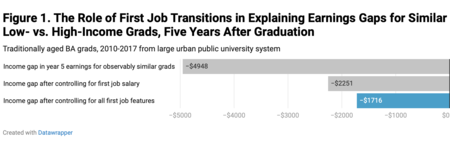
The consequences of these findings are significant. Research suggests that if the first job largely determines future income, then policies aiming to elevate economic mobility must address this critical transition from education to employment by providing support in job placement, networking, and internships. Improving access to quality employers through early information or even structured programs could effectively reduce the inequalities that stem from social origin .
Delving deeper, it becomes clear that the weight of origin remains a powerful determinant in one’s early career choices. Evidence shows that the resources available before university—such as social networks , financial buffers, and information access—are still paramount when it comes to choosing that all-important first job. Those who can afford to take time off without pay can afford to wait for better positions, while those without that luxury often feel compelled to accept the first job offered.

Ultimately, the path to success is neither purely a matter of chance nor merit. It reflects the enduring advantages or disadvantages of an individual’s background, which often carry over into the professional arena. For a truly equitable labor market, concerted efforts are needed not just to help individuals gain degrees but to ensure that their entry into the workforce does not perpetuate existing societal inequalities.
In conclusion, we must rethink our approach towards educational equity . Addressing the earning disparities of young graduates demands a dual focus: promoting access to education while simultaneously smoothing the transition from academia to the job market. By doing so, we can help craft a society where opportunity and success become realities for all, irrespective of their social origins.