
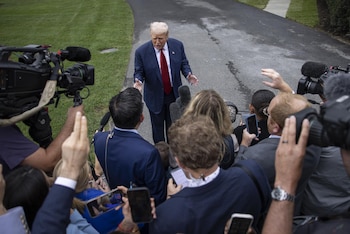
Trump’s Threats Against Major U.S. Networks: NBC and ABC Under Fire
The controversial remarks made by former President Donald Trump regarding major U.S. news networks NBC and ABC have once again ignited debates about media bias and free speech. Trump has openly threatened to revoke the broadcasting licenses of these networks, labeling them as a “real threat” to American democracy. This unprecedented stance raises crucial questions about the future relationship between the government and media entities.
Trump’s latest tirade came from his preferred communication platform, where he claimed that ABC and NBC provide him with an overwhelming 97 percent of bad news. Describing these networks as “fake news,” he asserted they have historically exhibited bias against him and the Republican Party. He stated, “Despite a very high popularity and, according to many, to be among the best eight months of presidential history, ABC and NBC give me 97 percent of bad news.”
Allegations of Political Bias
In his series of tweets, Trump accused both networks of acting as a “branch of the Democratic Party.” This accusation ignites longstanding tensions between the political right and major media outlets. He suggested that their overt bias and misrepresentation present a serious danger to democracy. Trump went so far as to state that the Federal Communications Commission (FCC) should consider revoking their licenses to operate. He expressed agreement with those who stand by this claim, reiterating that corrupt journalism should not be rewarded but eradicated.
“Corrupt journalism should not be rewarded, (but) eradicated,” he added emphatically. Such rhetoric has led to concerns about the implications of government censorship over media outlets, raising alarms among journalists and First Amendment advocates alike.
Calls for Financial Accountability
In a further twist, Trump suggested that both NBC and ABC should “pay millions of dollars a year” for their licenses if they want to continue operating. He claimed that their unfair coverage of Republicans and Conservatives justified such demands. “They should lose their licenses for their unfair coverage,” he declared, emphasizing the need for media organizations to be held accountable for their coverage.
This discussion about media accountability is particularly relevant in today’s digital age, where misinformation can spread rapidly through social media channels. The risks of censorship versus accountability have become critical topics among political analysts and media industry experts.
The Bigger Picture: Implications for Journalism
This outburst from Trump comes at a time when media organizations are increasingly scrutinized for their roles in shaping public opinion. Journalistic integrity has been challenged on multiple fronts, with accusations of bias emerging from both ends of the political spectrum. Notably, Trump’s statements followed an incident where major networks, including CBS and ABC, were embroiled in a legal dispute with him, landing a settlement of $15 million under defamation allegations last July.
Critically, the implications of Trump’s threats have led to discussions about the intersection of political power and media freedom. Observers point out that such high-profile criticism can jeopardize journalism’s role in serving as a check and balance on governmental power. Media independence is essential for a healthy democracy, allowing diverse viewpoints to be expressed and debated publicly.
Public Reaction and Consequences
Reactions to Trump’s threats have been swift. Many journalists and media watchdog organizations condemned his remarks, viewing them as dangerous rhetoric that undermines freedom of the press. Critics argue that the former president’s desire to regulate the media might create a chilling effect, discouraging journalists from conducting investigative reporting or conveying critical information regarding government actions.
Contrastively, some supporters laud Trump’s claims, believing that mainstream media outlets need to be held accountable for perceived biases. This division further polarizes discussions about journalism, complicating the landscape for those attempting to navigate truthful reporting in a divided nation.
The interplay of media, politics, and public perception is at a critical junction. In an age where information is often manipulated for political ends, maintaining a robust and independent media is essential for the health of democracy. Every challenge posed to journalistic integrity raises crucial questions about free speech and the ever-evolving relationship between power and the press.
In conclusion, while Trump’s comments reflect a significant tension between the media and political entities, they also evoke important conversations about the future of journalism in America. The ongoing struggle for understanding between reporters and politicians will continue to shape the media landscape for years to come.