
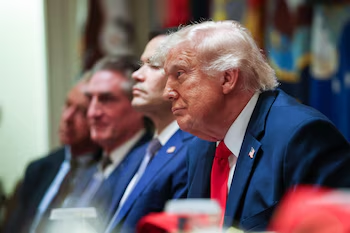
Trump’s Announcement
The United States President, Donald Trump, confirmed on Sunday that an agreement with Iran has been successfully negotiated, effectively updating the geopolitical landscape in the region. This agreement includes the immediate reopening of the Strait of Hormuz and the lifting of the US naval blockade that had been enforced in that strategic area.
In a message shared across his social media platforms, Trump expressed his satisfaction, stating that the pact with Iran is now finalized. He joyfully declared, “The deal with the Islamic Republic of Iran is now complete. Congratulations to everyone!”
Details of the Agreement
In his announcement, Trump emphasized the scope of the reopening, stating, “I hereby fully authorize the toll-free opening of the Strait of Hormuz.” This proclamation was accompanied by a confirmation of the cessation of US naval operations in the region, highlighting a significant shift in America’s military posture.
Trump reiterated his authorization for the immediate elimination of the naval blockade, which has been in place since the escalation of tensions in the area. He concluded his announcement by urging maritime traffic to resume, humorously adding, “Ships of the world, start your engines. Let the oil flow!”
The Role of Pakistan in the Negotiations
Prior to Trump’s official announcement, Pakistani Prime Minister Shehbaz Sharif revealed that diplomatic negotiations between Washington and Tehran had culminated in a fruitful understanding aimed at restoring peace in the Middle East. Sharif stated through a public statement that the talks had apparently concluded successfully, with a formal signing already scheduled for June 19 in Switzerland.
Multinational Diplomatic Efforts
Sharif characterized the agreement as a result of extensive diplomatic discussions, indicating that it includes the immediate and permanent cessation of military operations on all fronts. This framing also extends to Lebanon, a significant flashpoint in the region.
The Pakistani leader extended gratitude to all who participated in the mediation process, specifically mentioning Qatar as a pivotal facilitator in conversations between the two nations, alongside the contributions of Saudi Arabia and Türkiye.
He expressed hope that the forthcoming meetings will establish the necessary groundwork for effective implementation of the agreement. With these collaborative efforts acknowledged, the region might finally witness a much-needed shift toward stability.
Implications for the Global Oil Market
The reopening of the Strait of Hormuz is particularly critical, as it serves as a major waterway for oil transportation from the Persian Gulf to global markets. With approximately 20% of the world’s oil passing through this strait, the agreement is expected to have profound implications for global energy supply and pricing.
As shipping resumes, market analysts will closely monitor oil prices and supply chain stability, assessing how the lifting of the blockade influences the dynamics in global oil markets. The anticipated flow of oil from the Arabian Peninsula can shift economic forecasts and contribute to stabilizing prices in the energy sector.