
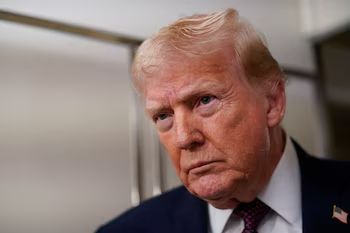
Trump Considers Military Action Amid Iranian Regime’s Brutal Repression
President Donald Trump recently expressed his grave concern over the violent crackdown on protesters in Iran, stating that the regime is “crossing a line.” Reports suggest that the U.S. is evaluating “very strong options” in response to the Iranian government’s aggressive repression, which has reportedly resulted in significant civilian casualties.
Context of the Protests
The protests erupted two weeks ago, initially sparked by rising living costs. However, they quickly evolved into a broader movement against the theocratic regime that has ruled Iran since 1979. As per the Human Rights Activists News Agency, over 500 individuals have lost their lives during these protests, marking one of the deadliest episodes in Iran in recent years. Among the deceased, 490 are reported to be protestors, while 48 were members of security forces.
Trump’s Remarks on Military Intervention
Speaking aboard Air Force One, Trump remarked that military officials are currently examining the situation closely and that the U.S. is considering strong military responses. He emphasized, “Iran is starting to cross (my red line). It seems that there are people who died who should not have died.” This rhetoric indicates a potential shift in U.S. policy, moving from diplomacy to military readiness.
Trump highlighted that Iranian leaders have made attempts to negotiate, but he cautioned that the U.S. might have to act before any formal discussions take place. This statement comes at a moment when Iranian authorities are also escalating their threats in response to U.S. intervention warnings.
Iranian Leadership’s Response
Tehran’s officials reacted angrily to Trump’s statements, with Parliament Speaker Mohamad Bagher Ghalibaf asserting that any U.S. military action would make “both the occupied territory and the military and naval centers of the United States our legitimate objectives.” The Iranian regime has also declared three days of national mourning for fallen security forces, characterizing the protestors as “urban terrorist criminals.”
Continued Unrest in Iran
Despite the government’s threats and an ongoing internet blackout that has lasted over 60 hours, protests persist throughout various cities, including Tehran and Mashhad. Social media has played a crucial role in disseminating images and videos of the protests, demonstrating the people’s defiance against oppressive measures.
According to reports from the Center for Human Rights in Iran, hospitals are overwhelmed with casualties from the unrest. Eyewitness accounts reveal alarming levels of violence, including serious injuries sustained by many protestors.
International Perspectives
Amid these developments, international leaders have expressed solidarity with the Iranian people. Israeli Prime Minister Benjamin Netanyahu hoped for the Persian population’s liberation from oppression, emphasizing the global support for Iranian dissent.
Prominent opposition figures, such as Reza Pahlavi—son of the former Shah—have called for armed forces and public employees to join the protests. He has even indicated his willingness to return to Iran from exile to facilitate a democratic transition.
Conclusion
As the situation unfolds, the stakes are escalating for both the U.S. and Iran. Trump’s contemplation of military intervention marks a pivotal moment in U.S.-Iran relations. With the likelihood of heightened tensions, the international community watches closely as the Iranian people continue to brave the harsh response of their government in their quest for freedom.