
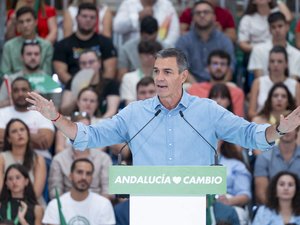
In the aftermath of the recent Vuelta a España cycling event that culminated in Madrid , Prime Minister Pedro Sánchez has voiced his strong support for pro-Palestinian demonstrators . On September 15, he stated that Israel should be excluded from international sports competitions until what he termed “barbarism” in Gaza ceases. This declaration comes amid heightened tensions between Spain and Israel , further straining diplomatic relations that have been rocky for several months.
The chaotic end of the Vuelta saw demonstrators take to the streets, and Sánchez expressed admiration for those who protested for their convictions. He noted, *“We, of course, always reject violence. We feel immense respect and a deep admiration for a Spanish civil society which mobilizes against injustice and defends its convictions in a peaceful way.”* His comments underscore a growing political climate in Spain that increasingly aligns with pro-Palestinian sentiments.
Boycott of Eurovision Envisaged
In addition to the protests during the Vuelta, Sánchez’s remarks have also stirred discussions about potentially boycotting the Eurovision song competition if Israel continues its participation. Citing historical precedents, he drew parallels with the international community’s response to Russia after the invasion of Ukraine , suggesting that similar measures should be taken against Israel.
His Minister of Culture, Ernest Urtasun , echoed these sentiments by suggesting that Spain should reconsider its participation in the upcoming Eurovision as long as Israel remains involved. This highlights Madrid’s desire to respond to perceived injustices happening in Gaza while maintaining a stance that seeks to unify grassroots expressions of solidarity through artistic and sporting avenues.
The events that unfolded during the Vuelta have not only captured the headlines but have also escalated criticisms within Spanish politics. Opposition leaders have accused Sánchez’s government of failing to manage the protests effectively and even of inciting them. Alberto Núñez Feijoó , leader of the People’s Party , lambasted the government for allowing the cycling event to be interrupted, claiming it led to a situation that embarrasses Spain on the international stage.
“Intolerable That We Sow Hostility”
Relations between Spain and Israel have been particularly strained since Spain officially recognized the state of Palestine in 2024 . Recent statements from Sánchez reflect an unwavering commitment to reassessing Spain’s role on the international stage, particularly regarding issues of social justice. In light of prior anti-Semitic demonstrations linked to Palestinian support, the Federation of Jewish Communities of Spain (FCJE) has voiced concerns, stating, *“Any permissiveness in the face of violence constitutes a democratic decline and a serious risk for social cohesion.”* This statement underscores the delicate balance Madrid must navigate as it supports a significant aspect of its electorate while also addressing criticisms from minority communities within the country.
The FCJE emphasized that hostility towards the Jewish community, which comprises approximately 45,000 individuals within Spain, is unacceptable , urging the government to take a stand against any actions that could incite hatred.
Public sentiment in Spain appears to be influenced by a growing pro-Palestinian movement that has disrupted major events, including this year’s Vuelta. Demonstrators have demanded the exclusion of Israel and have frequently targeted Israeli runners. This ongoing tension reveals the complexity of public sentiment surrounding the Palestinian cause, where many feel compelled to advocate for justice while ensuring that actions do not inadvertently foster division within society.
To conclude, the incidents related to the Vuelta and the subsequent comments from officials have sparked a national dialogue, illustrating the intricate web of sports, diplomacy, and public opinion. Leaders are faced with the challenging task of balancing activism with the practicalities of governance. As campaigns for justice gain traction, the government must navigate these turbulent waters judiciously, ensuring unity while advocating for those they represent. All eyes will remain on how these developments unfold, considering Spain’s pivotal role in the broader discussions about the ongoing conflict between Israel and Palestine.