
We live surrounded by increasingly modern cities, connected by transport networks, technology, and services that seem to completely define our time. However, in different corners of the planet, there persist material traces of ancient societies that built works destined to last longer than those who built them, reminding us that the human ambition to transcend is not an exclusive feature of the present. One such structure is found in Anuradhapura, an ancient city in Sri Lanka, which remains a significant yet relatively unknown marvel beyond its immediate surroundings.
Located in the central north of the island, Anuradhapura served as the first major capital of Sri Lanka and is regarded as one of the most sacred places of Buddhism. This site showcases the continuity of Buddhist practice, with full moon days drawing barefoot pilgrims dressed in white who walk along dusty paths. Monks chant at dawn, and foreign visitors participate in centuries-old rituals, enriching the spiritual tapestry of this unique environment.
Jetavanaramaya: The Brick Dome That Defied Time
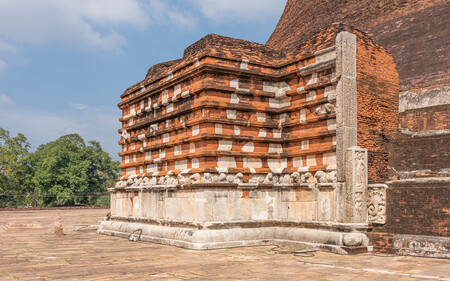
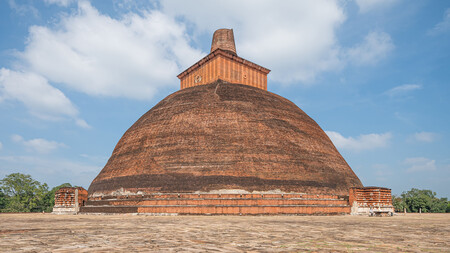
The architectural centerpiece of this complex is the Jetavanaramaya stupa, a monumental structure that challenges the imagination with its scale. Completed around 301 CE, it utilized approximately 93.3 million bricks of baked clay, soaring to about 122 meters—ranking it as the third largest construction ever made by humans, behind the Pyramids of Giza.
Today, Jetavanaramaya stands at around 71 meters due to years of deterioration and restoration. Despite this, it remains the largest known brick construction. In fact, historical sources suggest its bricks could build a wall nearly three meters high between London and Edinburgh. Originally covered by vegetation, this ancient engineering marvel remained largely ignored outside of its region for centuries.
Beyond its architectural significance, the stupa is integral to a complex religious organization that defined the monastic life of its time. The Jetavana Vihara complex was designed to accommodate a large community of monks, centering spiritual practice around the stupa, which is visible from every part of the complex.
The strategic choice of brick as the primary building material shaped the project’s logistics. In contrast to stone constructions like the Pyramids of Giza, the stupa demanded the preparation, transportation, and assembly of countless pieces that were more prone to erosion. Ancient oven remnants reveal extensive brick production in the region, although a conclusive timeline remains elusive.
In addition to its architectural intrigue, Jetavanaramaya holds mysteries within. Archaeologists uncovered reliquary chests at various construction levels, affirming their purpose as containers of religious significance. Surrounding these chests were gold panels adorned with bodhisattvas, now preserved in the Colombo National Museum. These findings offer tangible proof of diverse religious practices and indicate that the site participated in cultural interactions across the Indian Ocean.
What is perhaps most remarkable is that this structure has survived for over 1,700 years, remaining unmatched in scale for centuries thereafter. Jetavanaramaya symbolizes the zenith of a construction tradition that evolved into new forms and proportions. Its existence serves as a testament to societies that, long before modern times, demonstrated extraordinary abilities in coordinating labor, technical ingenuity, and collective beliefs.
Images | erdbeernaut (CC BY-SA 2.0) | Wimukthi Bandara (CC BY-SA 4.0)