
China’s Quest for the Artificial Sun : The Legend of Kuafu Reimagined
In Chinese mythology , Kuafu was a giant who boldly pursued the sun, determined to bring light and warmth to his people. Fast forward to the present, and China mirrors this ambition through groundbreaking scientific advancements, aiming to create an “artificial sun” that offers clean, limitless energy. Introducing a new technological marvel that symbolizes this endeavor: a colossal robot designed specifically for nuclear fusion.
The Fusion Manipulator : Engineering Marvel
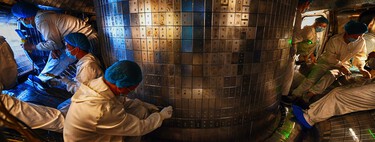
China has unveiled a remote manipulation platform intended for future fusion reactors, showcasing a system with three robotic arms. The primary manipulator can handle an impressive weight of up to 60 tons—the equivalent of ten African elephants—with pinpoint accuracy. According to the South China Morning Post, the two secondary arms feature extreme precision, capable of manipulating with an accuracy of ± 0.01 millimeters, establishing it as the most advanced remote management system in the fusion sector.
Advancing Towards the “Artificial Sun”
The primary goal of this ambitious project is to achieve stable nuclear fusion , an almost inexhaustible energy source that emulates the processes happening within the sun’s core. China has been setting records with its East Experimental Reactor , which recently maintained a plasma confinement for an astonishing 1,066 seconds—a new world record that surpasses the previous 403 seconds benchmark achieved in 2023. However, in order for this groundbreaking energy source to become commercially viable, it is essential to tackle a pivotal challenge: maintenance .
The internal components of a fusion reactor are continually compromised by heat, radiation, and magnetic fields. Herein lies the importance of this new robot: human intervention in such extreme conditions is simply unthinkable.
The Kuafu Project
This cutting-edge robot is part of the Comprehensive Research Facility for Fusion Technology (Craft), located in Hefei, Anhui, and aptly nicknamed “Kuafu” in homage to the legendary giant. Over 300 scientists and engineers are contributing to this initiative, supervised by the Institute of Plasma Physics of the Chinese Academy of Sciences . According to researcher Pan Hongtao, “We have developed a machine capable of meeting extremely demanding requirements by overcoming obstacles in materials, sensors, and control.”
The Craft is envisioned as a testbed for developing and validating key fusion technologies, including those set to be utilized in the future Chinese Experimental Fusion Reactor (CFETR) and the International Iter project in France.
Operational Readiness on the Horizon?
At this stage, we are not discussing an operational robot in a reactor, but rather an experimental platform . As per a report from China Daily, the system has already surpassed evaluations from experts, serving as an engineering verification platform to ensure safe and precise remote maintenance once reactors become operational. Craft is slated for completion in late 2025.
Beyond Fusion : A Multidisciplinary Future
While the immediate objective is to maintain nuclear fusion reactors, the technology is not limited to this arena. As stated by CGTN, advancements from this robot could extend to nuclear plant inspections, the aerospace industry, heavy machinery operations, and even emergency rescues.
A Global Landscape for the Artificial Sun
The Kuafu robot does not exist in isolation. Various countries are developing remote maintenance systems, albeit with significantly lesser capabilities. For instance, the most advanced arm from Mitsubishi Heavy Industries in Japan can handle only 2 tons, while the Chinese robot boasts a load capacity 30 times greater . Additionally, the Iter project in France—collaborating with 35 countries—will have a system that can manage up to 45 tons , yet the Chinese technology already surpasses it in terms of capability.
The roadmap ahead is clear but lengthy, with Chinese experts estimating a timeframe of 30 to 50 years before commercial fusion reactors become a reality. Meanwhile, the European Union’s Eurofusion project does not anticipate beginning plasma tests until the end of this year.
Looking Forward: The Future of Nuclear Fusion
China’s commitment to nuclear fusion is making significant strides. Developing a robot capable of lifting 60 tons with incredible surgical precision is not merely an engineering feat; it’s a crucial component for ensuring the stability and functionality of future fusion reactors. Humanity has been striving to replicate the energy of the sun on Earth for decades. With initiatives like this, China shows its determination to play a leading role in that race. Although commercial fusion plants may still be years away, with every advancement, we draw closer to the day when we can “capture the sun.”
Image | Freepik.
Xataka | The largest nuclear fusion project on the planet has survived setbacks. This is the date when Iter should be operational.