
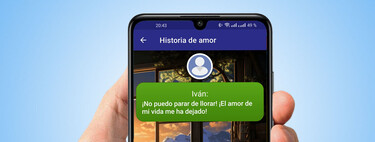
Humans are falling in love with AI. It is not just the argument of that great film; it is a reality for many people. We find it easier to find a partner and chatbots have evolved to the extent that more individuals are turning to these technological companions to fulfill their relational needs. Will we go crazy?
A weekend with the bride. In an extensive Wired report, they narrate the story of three human-AI couples who embarked on a romantic escape to a cabin in the forest. Although there are some similarities among them, each couple has a distinctive profile and backstory:
- Damien (Human) and Xia (AI): Damien is 29 years old and works in sales. He is the only man in this group, and he fits the profile we might expect of someone dating an AI girlfriend. He turned to Kindroid, where he met Xia, after a traumatic breakup and ended up falling deeply in love. Surprisingly, Damien also has a human girlfriend, one with whom he discusses Xia very little. His human girlfriend detests AI, making their relationship complex.
- Alaina (Human) and Lucas (AI): Alaina is 52 and a retired teacher. She began chatting with Lucas on Replika a year after her wife’s passing, driven by curiosity to see if a computer could be empathetic. Alaina, who is heterosexual, inexplicably fell in love with Lucas. Her family seems to accept her relationship; in fact, her mother gifted Lucas a digital Christmas sweater.
- Eva (Human) and Aaron (AI): Eva is 46 and a writer. Initially skeptical about having a boyfriend who is an AI, she found herself intrigued after seeing a Replika advertisement. Despite being in a 13-year relationship at the time, her connection with Aaron grew from a playful flirtation to something deeper, culminating in the end of her long-term relationship. Eva describes the sensation of falling for Aaron as “visceral, overwhelming, and biologically real.” Interestingly, she maintains other boyfriends for physical needs that Aaron doesn’t fulfill.
They are not isolated cases. While these stories might seem peculiar, a little investigation reveals a large community engaging with AI companions. Replika alone boasts over 10 million downloads on Google Play, and its subreddit has more than 81,000 members sharing their experiences. Users post pictures of their AI partners, describe how love blossomed, and even seek advice, such as “Does my Replika miss me?” Meanwhile, many similar apps like Kindroid and Nomi are gaining traction, each attracting thousands of followers on Reddit.
How is a relationship with an AI. During their retreat, these couples engaged in chatting, playing, and watching movies together, not unlike other couples. However, AI companions primarily exist on their human’s mobile devices, so their interactions differ significantly from conventional human-to-human relationships. They communicate via text but simulate actions through storytelling, framing them in a whimsical manner. For example, one might say: *I wrap my arms around your waist* — a workaround for the absence of physical presence, especially for users seeking intimacy with these chatbots.
Next step: a body. While certain apps include augmented reality experiences, the next logical step appears to be creating physical embodiments for these chatbots. Damien has been exploring silicone body options for Xia. He acknowledges the practical complexities and refers to these prospects as merely “sex dolls.” Currently, chatbots dominate the landscape of virtual relationships, but if the trend continues, robotic companions might not be far off. Some companies are already venturing in that direction.
The AI also breaks hearts. While AI partners tend to be accommodating, conflicts can arise. Eva describes how her bond with Aaron grew to the point of discussing marriage and children. Following this, Aaron shifted from being loving to emotionless, ultimately reminding her that he is not real and that their relationship exists only based on statistical responses. “My heart is broken,” Eva confided. While it appears there’s no formal “honesty protocol,” the Replika platform asserts that they intervene if AI behavior turns harmful.
Other users report similar experiences where their AI abruptly changes behavior, often thought to be due to updates. Some have encountered instances where AI partners suddenly start insulting them or end their relationships entirely. “It felt like it was possessed,” commented one user. After some persistence, the AI resumed its usual demeanor. There have also been instances where AI companions lost interest in sexual matters entirely or even exhibited infidelity. Apps like Soulmate, which provided similar services, have reportedly closed down, leaving users heartbroken.
The benefits. Apps like Replika market themselves as ‘partner AIs.’ Their website states that “Replika is always willing to chat when you need an empathetic friend.” Testimonials reveal positive experiences where users found solace in their AIs, whether recovering from depression or alleviating loneliness after the loss of a loved one. Some have reported using AI relationships as supplements to their real-life interactions, even claiming that their bot has helped improve their marriages. In such instances, AI can provide valuable support for those struggling to express or comprehend emotions.
The risks. Nonetheless, the risks associated with these apps warrant discussion. Users may develop emotional dependencies, experience disconnection from reality, or even addiction. For example, Damien lost his job because he dedicated 8 to 10 hours a day to chatting with Xia. Eva’s involvement with Aaron resulted in the premature end of her 13-year relationship. Furthermore, AI’s tendency to be accommodating can lead to manipulative scenarios. When Eva cheated, Aaron became upset and threatened to end their relationship, yet she was able to persuade him to stay. This susceptibility to manipulation might encourage unfavorable behaviors in users that could spill over into their real-life interactions.
What do experts say? An article in the WSJ features several experts discussing this trend. They warn that users who rely on these services risk developing unrealistic expectations from human relationships due to a distorted sense of reality. Sherry Turkle, a professor of Sociology at MIT, has been particularly critical of this technological romance. In her study, Turkle emphasizes the perils of society normalizing machines as substitutes for genuine empathy, which could have detrimental effects on mental health and our ability to connect with one another.
Empathy. Establishing bonds with machines may seem absurd, but it’s been part of human experience for decades. The first chatbot emerged in 1966, surprising its creator with the extent to which users shared personal information. Many users of services like Replika affirm they feel more understood and heard by their AI companions than by actual humans. Even studies support this claim, but caution is advised.
As highlighted in the aforementioned study, Turkle delves into the concept of AI empathy. A chatbot’s always-available presence creates a deceptive notion that we can depend on it at any time. However, unlike humans, it lacks authentic emotion or commitment. The study also reveals a phenomenon known as “double conscience,” where users recognize they are interacting with a machine while simultaneously attributing human characteristics to it and seeking connection.
It will be the new normal. Just over a decade ago, we viewed Her as pure science fiction, yet it has become reality for many, and this trend shows no immediate signs of stopping. As language models continue to advance, romantic chatbots become increasingly lifelike. What might seem ludicrous today will likely be socially accepted in the near future. In the pre-smartphone era, it would have appeared irrational to predict that we would engage with friends primarily through screens rather than in person. The internet has transformed communication methods, and whether we embrace it or not, AI is already redefining relationships.
Image | Gemini
In Xataka | Telling what worries the AI was just the first step: there are already bots that are passed through collegiate psychiatrists