

A Historic Flight: The Supersonic Concorde Pursuing the Solar Eclipse
After more than 50 years of silence from sonic booms, the United States has recently decided to open its skies to supersonic flight over land once again. An executive order signed by Trump has overturned the 1973 regulation prohibiting these operations on U.S. soil, a decision made in response to public complaints about the deafening noise produced by aircraft breaking the sound barrier, which can reach up to 110 decibels .
In that very year, a Concorde made its way to Gran Canaria to make history.
Concorde in the Canaries. On June 30, 1973, Spain became part of one of the most unusual and ambitious scientific experiments ever undertaken to study the Sun: a supersonic flight of the Concorde that followed the shadow of a solar eclipse over Africa. The geographical location of the Canaries, perfectly aligned with the eclipse’s trajectory, allowed the country to take part in an international operation led by scientists from the United States, France, and the United Kingdom, with logistical collaboration from the Spanish Air Force.
On that day, the Concorde prototype, still not in commercial service, took off from Gran Canaria after landing on June 27 with the island shrouded in haze. Its mission was not to transport passengers but to serve as a flying observatory capable of staying within the lunar shadow for a record time.
Supersonic Laboratory. The mission, developed and coordinated from Toulouse , transformed Concorde 001 into an unprecedented scientific platform . Its fuselage was modified by drilling its roof and installing quartz crystals that enabled cameras to capture infrared emissions from the sun without distortion from over 17,000 meters altitude.
While the British initially opposed modifying the aircraft, Air France enthusiastically accepted its temporary conversion into a flying laboratory . Inside, there were few seats as scientists had to hold on during maneuvers in a cramped space adapted for minimal observations. The rudimentary preparations, including manually cleaning the windows before takeoff, contrasted sharply with the scientific magnitude of the challenge they faced: recording phenomena that were impossible to see from the Earth’s surface due to atmospheric distortion .
From Gran Canaria to the Eclipse. On June 30, 1973, the scientific team aboard the Concorde prototype performed one of the most spectacular feats in the history of observational astronomy: they followed the shadow of a total solar eclipse over Africa for 74 uninterrupted minutes , thanks to the aircraft’s capability to fly at more than twice the speed of sound.
Don Liebenberg, an American physicist and organizer of the experiment, was one of the seven researchers on board who observed the curvature of the Earth and captured images of the solar corona, the critical region of the Sun whose emissions can affect everything from satellites to power grids on Earth.
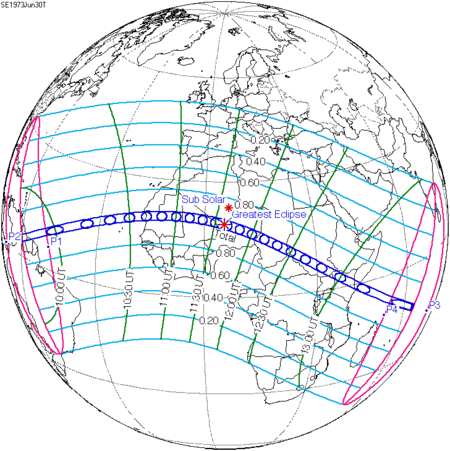
Path of the eclipse’s totality
The Challenge. Equipped with infrared cameras installed in windows cut into the aircraft’s roof, the Concorde 001 took off from the island and crossed the Sahara behind the moon’s shadow, achieving prolonged observations that had never before been witnessed.
However, the scientific results, like the first indication of oscillations lasting five minutes in corona intensity, though technically impressive, had a limited impact: much of the material remains uncatalogued and no significant conclusions were published.
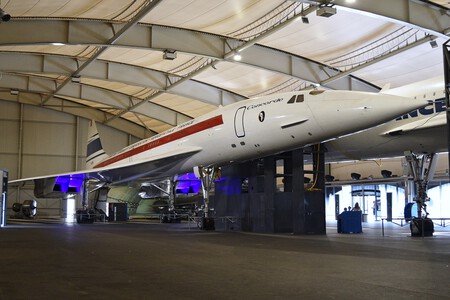
The Concorde 001 on display
A Feat Beyond Results. Despite the spectacular images and technical audacity of the mission, the scientific legacy of the Concorde flight was modest . Most of the data, archived in hundreds of rolls of 35 mm film, was never digitized due to a lack of resources, and analyses were never formally completed. However, the flight left an indelible mark on the collective memory of astronomers and space exploration enthusiasts alike.
Liebenberg himself, now an adjunct professor at Clemson, reminisced to National Geographic about the moment the Concorde penetrated the moon’s shadow at Mach 2.2 , enveloping the sky in darkness in broad daylight. Despite the lack of immediate scientific profitability, the experiment served as a model for future missions and demonstrated the potential of supersonic flights in solar research, a field that remains active half a century later.
Historical Milestone. Although the Concorde would return to visit Spain in 1977 (now in commercial service and under the sponsorship of El Corte Inglés), its 1973 stop in the Canaries was far more significant. It not only represented the first operational use of the aircraft for an international scientific mission but also solidified Spain’s position as a relevant player in solar research and European aerospace logistics.
This flight, often forgotten by the general public, symbolizes an era of bold experimentation , where the boundaries between aviation, astronomy, and geopolitics blurred at the speed of sound.

Touching the Myth. Thus, it was not just an experiment but a collaborative effort that showcased international science and technical innovation, which has now reopened a door with new tools. For Liebenberg, the eclipse of 1973 was an unforgettable sensory experience: the absolute darkness at Mach 2, the view of a curved horizon, and the shared excitement among a handful of researchers determined to chase the moon’s shadow.
Half a century later, the Concorde, with its perforated roof and hand-cleaned windows, remains a testament that, for a fleeting moment, science caught the eclipse , and Spain was there to witness it.
Images | Spaceaero2
In Xataka | The Bombardier Global 8000 is preparing to enter service: it will be the fastest civilian aircraft since the Concorde
In Xataka | 20 years ago, the Concorde took off for the last time: this is what the plane favored by businessmen and celebrities looked like