
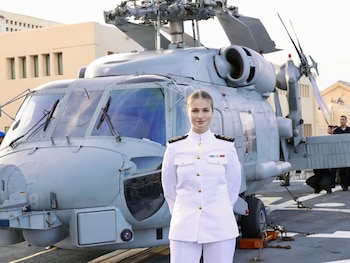
The Journey of Princess Leonor into Military Aviation
Just a month after finishing her instruction at the Naval Academy of Marín, Princess Leonor has enjoyed a well-deserved vacation with her family, including King Felipe, Queen Letizia, and her sister, Infanta Sofia. Their summer getaway began with traditions in Palma de Mallorca, followed by a private retreat in Greece. However, the time of leisure is drawing to a close as Princess Leonor prepares for her third and final year of training, leading her journey toward becoming the future Chief of the Armed Forces.
On September 1, she will enter the General Air Academy in San Javier, Murcia. This will be her new training ground, where she will be treated like any other student—without privileges, despite being the heiress to the throne. The academy has strict rules of discipline that all students must adhere to, featuring a rigorous schedule packed with academic and practical instruction.
Early Rising and Rigorous Schedule
The daily routine for Princess Leonor will begin early—at 6:30 AM—with the sound of Diana (the morning bell). Following a brief breakfast with her peers, classes commence at 7:40 AM and continue until 3:00 PM, interrupted only by a short break. The afternoon continues after a quick recess until 6:00 PM, culminating in a study period until 10:15 PM. Dinner is generally served at 8:30 PM, and silence is enforced at 10:30 PM.
This military lifestyle is not unfamiliar for Princess Leonor, who has already undergone training at the General Army Academy in Zaragoza and the Naval Military School in Marín. As she steps into San Javier, she will resume her responsibilities as a fourth-year student, having already attained the rank of Ensign.
Challenges Ahead: Learning to Pilot
One of the main goals for Princess Leonor during her time at the General Air Academy will be to learn how to pilot an aircraft. Colonel Luis González Asenjo, the academy director, mentions that they are refraining from providing a timeline for when she might first take to the skies with an instructor in one of the PC-21 Pilatus training aircraft.
Her journey towards flight begins with theoretical classes, followed by simulators—specifically the Computer Based Training (CBT), which allows students to familiarize themselves with flight instruments before attempting actual flights.
The next phase involves using the Full-Flight Training Device (FTD), which simulates a real cockpit environment. This advanced simulator provides a nearly authentic flying experience with a 180-degree field of view. This training aims to help students feel comfortable in the cockpit before experiencing their first actual flight.
Classroom Dynamics and Skill Development
Training sessions in the simulator typically last between one to one and a half hours. Instructors can create emergency scenarios to help students develop quick decision-making skills for unanticipated situations while flying. As for Princess Leonor, she will not be exempt from these challenging conditions.
Initial flights with an instructor serve to build the necessary confidence before a student transitions into learning about the aircraft’s instruments. Once comfortable, they progress to joint maneuvers and aerobatics, all under close supervision.
Achieving what is known as ‘loose’ flying—an aviator’s first solo flight—depends on the student’s readiness. There are no guarantees, even if students have met all requirements. Experience shows that some students might not progress to solo flying, illustrating the complexities of aviation training.
Maintaining Composure and Health
Before taking to the skies, Ensign Bourbon, like all pilots, must be mindful of crucial guidelines. Optimal hydration is essential: an 80-kilogram pilot must drink over one liter of water at least two hours prior to flying, replete with further hydration while airborne. This helps manage the physiological stressors faced when piloting.
Socializing and Living Spaces
Princess Leonor is set to integrate fully into campus life on September 1. According to Defense Minister Margarita Robles during her recent visit, Leonor will live alongside three other female students in shared accommodations. These living arrangements limit privacy, as students often share bathroom facilities down the hall.
Each cadet is assigned a bed, closet, desk, and other basic necessities. While the academy covers various uniforms, it suggests that students pack essential items such as sunblock, mosquito repellent, and even basic first aid supplies.
As Princess Leonor transitions into this rigorous and disciplined education, she not only carries forth a family legacy but also embraces the challenges and responsibilities that come with her future role in the Spanish Armed Forces. Facing the unknowns of flying and leadership, her journey is one of immense personal growth and national significance.