
We will never know for sure if James Cameron was aware during the filming of ‘Titanic’ of what he was creating. However, one aspect that is clear is that he deliberately crafted a poignant ending for the story. At this point, it’s no revelation that the death of Jack Dawson , played by Leonardo DiCaprio, has become one of the most iconic moments in cinematic history. But was it truly inevitable? The lingering question remains: Could Jack have survived? Surprisingly, evidence pointing to a potential survival lies within the very frames of the film itself.
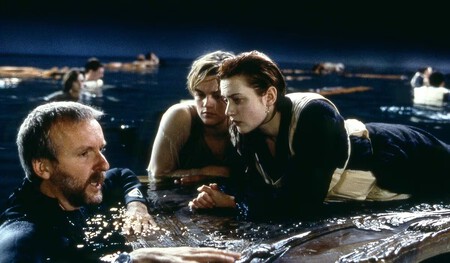
To analyze one of cinema’s most discussed deaths, we must acknowledge the popular belief that Jack could have been saved . This debate ignited when audiences noted that when one person occupies a floating table, it would seem feasible for a second person to join them. Yet, Jack chose not to climb aboard, leaving Rose to watch him perish while he succumbed to the icy waters. This decision steered conversations for years, igniting a storm of controversy.
The debate took a scientific turn in 2012 when the popular program Mythbusters aired an episode that tested this very question. They simulated the situation by creating a raft using dolls. To their astonishment, when they constructed a large-scale replica, they found that Rose could have removed her life jacket and placed it under the wooden plank, ultimately allowing both characters to remain afloat. The analysis concluded that Jack’s death was unnecessary. This viral testing invited further scrutiny, leading Cameron to defend his artistic choice.
Facing the persistent curiosity and speculation, Cameron grew weary. In 2017, he characterized the assertions as “sadistic” and lacking scientific rigor. Despite acknowledging that Jack’s death was a matter of artistic license, he found it necessary to offer a more conclusive rebuttal. Cameron later revealed that he conducted extensive research to investigate the buoyancy of the wooden plank.
In his experiment, Cameron used body doubles that matched the weight of DiCaprio and Winslet. They equipped the replicas with sensors and submerged them in icy water, only to discover that only one person could have survived on the floating door. This finding, Cameron insisted, illustrated that “Jack needed to die.” He likened it to Romeo and Juliet, emphasizing that the film’s themes were intrinsic to love, sacrifice, and mortality.
Amidst the myriad of fictional tales surrounding the Titanic, one character stands out—a real-life survivor named Charles Joughin . Serving as the ship’s baker, Joughin was resting in his cabin when tragedy struck. Initially tasked with sending provisions to the lifeboats, he later helped women and children escape while notably consuming whiskey during the chaotic descent into the abyss.
This true story highlights an intriguing aspect that is often overlooked in discussions about survival. Throughout the various inquiries into Titanic’s sinking, Joughin divulged that he managed to stay afloat in the frigid waters. Describing himself as buoyant, he recounted how he stayed above the freezing depths without succumbing to hypothermia.
While Joughin’s story serves as a testament to human resilience, it also juxtaposes cinematic fiction with historical fact. Scientific studies indicate that the icy waters of the North Atlantic were around -2 °C on the night of the disaster. Most individuals succumbed to hypothermia within thirty minutes; however, Joughin’s continuous swimming and movement likely played a critical role in prolonging his survival.
Medical experts estimate that hypothermia sets in quickly, with body temperature plummeting below 25 °C leading to cardiac failure. Conversely, Joughin’s unyielding spirit kept him afloat for over two hours until he located a boat that could rescue him, paralleling the harrowing escape depicted in the film.
Returning to the alcohol factor, it’s intriguing to note that during his ordeal, Joughin had consumed a considerable amount of whiskey. While alcohol is generally known to exacerbate hypothermia, in this scenario, it may have prevented his body from totally shutting down and aided in his survival due to its depressant effects on the central nervous system.
After surviving Titanic, Joughin’s life continued to be filled with adventure. He served on another vessel, the SS Congress, until tragedy struck again when a fire resulted in its sinking. However, this time, Joughin was among those safely evacuated.
Ultimately, Charles Joughin succumbed to old age in December 1956, remembered forever as the “Baker of the Titanic.” His tale serves as a poignant reminder that while fiction may dictate a character’s fate, the real stories often leave us with more questions than answers, leaving the spirit of survival intertwined with tragic heroism.