
Covered by 192 solar panels , the Blue Marlin appears more as a floating installation than a traditional freighter. However, under its futuristic exterior lies a remarkable advancement: this ship is the first of its class capable of using solar energy for propulsion. Unlike previous implementations of solar technology on ships, the Blue Marlin’s panels don’t just power auxiliary or lighting systems; they directly feed its electric propulsion system, enabling it to sail autonomously using renewable energy.
The technical advancement of the Blue Marlin extends beyond aesthetics. This ship combines solar energy , batteries , and diesel generators into a hybrid system designed to adapt to varying conditions during its journey. Under optimal sunlight, the solar panels can generate up to 35 kilowatts , sufficient for the propulsion system’s needs without resorting to external energy sources. During less favorable conditions, the system implements Peak Shaving , an automatic management feature that minimizes diesel generator usage, employing them only when absolutely necessary.
Solar Panels and Diesel: A Unified Approach
Solar energy has been featured in several maritime projects before, from cruise ships outfitted with solar panels to innovative sails using perovskite technology that promise sustainable maritime travel . Some pioneers even attempted to circumnavigate the globe using solar power over a decade ago. However, the Blue Marlin is not designed for such extensive journeys. Its mission is far more specific—it aims to transport steel and bulk materials within northwestern Germany.
These transport routes, which navigate through intricate inland channels, are crucial for reducing reliance on trucks and decreasing emissions in logistics. By adopting electric propulsion, Blue Marlin facilitates a reduction of nearly 36,000 kilograms of CO2 emissions per year—a significant figure for a single vessel.
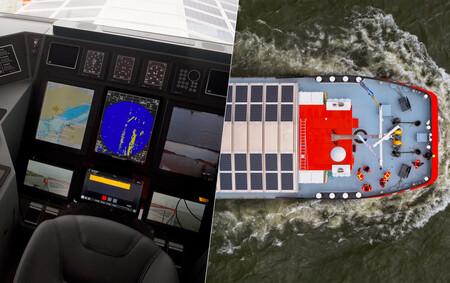
In addition to its hybrid propulsion system, the Blue Marlin integrates another significant innovation: remote navigation . Utilizing Seafar technology , the ship can navigate some stretches of its journey without crew onboard. After extensive testing, German authorities have authorized the Blue Marlin to operate telecontrolled between Salzgitter and Friedrichsfeld. This development not only slashes operational costs but also paves the way for a new logistics model that allows for part of the control to be managed from the ground.
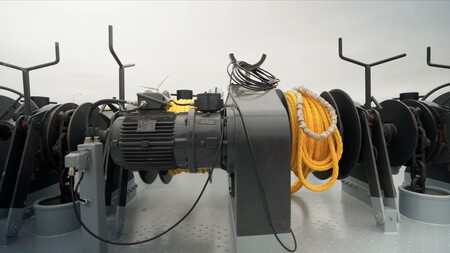
A key challenge in river transport is to maintain operability during low water levels. Blue Marlin has been specifically designed to address this issue. Its hull is engineered to ensure stability and maneuverability even with a draft of only 1.10 meters . With its Veth propellers and an additional bow propeller, Blue Marlin can navigate precisely through complex waterways, making it a valuable asset in today’s increasingly unpredictable environment.

Behind the Blue Marlin are two pivotal entities: HGK Shipping, which transports approximately 43 million tons of freight annually across Europe, and Salzgitter AG, a leader in steel production on the continent. Together, they have developed a vessel that not only serves a logistics function but also symbolizes a necessary shift towards a more sustainable future. The construction of the vessel unfolded in several phases and countries, adhering to strict engineering standards.
Images | HGK Shipping GmbH
In a world increasingly turning towards innovative and sustainable solutions, the Blue Marlin represents a significant milestone in inland shipping. Its blend of renewable energy and advanced technology signals a shift in how we approach logistics, paving the way for a future where transport is not only efficient but also environmentally responsible.