
Spotify Launches Lossless Audio for Premium Users
After years of anticipation and delays, Spotify has finally begun to roll out its lossless audio feature for premium users in select markets. This long-awaited upgrade enables Swedish music enthusiasts to experience FLAC streaming at a resolution of up to 24-bit/44.1 kHz, delivering a richer and more detailed listening experience. This crucial update fulfills one of the most frequently requested features from subscribers.
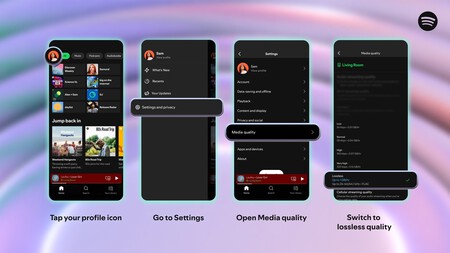
How to Activate Lossless Streaming
Premium subscribers will receive a notification through their Spotify application once the lossless audio feature becomes available to them. Users will then have the option to manually activate this feature through the settings menu, specifically under “Media Content Quality.” Different quality settings can be selected for both Wi-Fi and mobile data , as well as for downloads. The feature is accessible on a variety of devices, including mobile phones, computers, and tablets, in addition to smart speakers equipped with Spotify Connect from brands like Sony, Bose, Samsung, and Sennheiser.
The Long Wait is Over
Spotify first announced its plans for high-quality audio back in 2021, promising a “HIFI” level that, until now, had not materialized. Meanwhile, competitors like Apple Music launched their own lossless streaming service in the same year, while Amazon Music followed suit after introducing an HD tier in 2019. “The wait has finally ended. We are thrilled that lossless audio is now being deployed for our premium subscribers,” said Gustav Gyllenhammar , Vice President of Spotify subscriptions.
Technical Limitations and Recommendations
While this new feature is a game-changer, there are some technical limitations to consider. According to Spotify, Bluetooth technology does not provide sufficient bandwidth to transmit lossless audio effectively. Thus, the platform recommends using a wired connection or speakers that connect via Wi-Fi with Spotify Connect . It’s also worth noting that higher quality audio files take up more storage space and may take slightly longer to load initially; however, once cached, playback becomes seamless and more fluid.
Comparing Spotify with Rivals
Spotify’s new audio offering supports 24-bit/44.1 kHz in FLAC format , while competing platforms such as Apple Music, Tidal , and Qobuz provide higher resolutions, reaching up to 24-bit/192 kHz. This disparity leaves room for Spotify to introduce additional premium tiers in the future, which many industry insiders have speculated about in recent months. Once you step into the realm of 24-bit audio, one needs a high-quality sound system, often worth several thousand euros, to truly notice the difference in sound quality.
Global Rollout and Availability
The rollout of the lossless feature is occurring gradually across more than 50 markets , with the full implementation expected to be completed by October. Users in Australia, Austria, Czech Republic, Denmark, Germany, Japan, New Zealand, Netherlands, Portugal, Sweden, the United States, and the United Kingdom will be among the first to access this new feature. The company claims that nearly all songs in its catalog of 100 million tracks will be available in lossless format, although some tracks may lack this capability.
Integrated Cost and Market Position
The lossless audio feature comes at no extra charge for premium Spotify subscribers, setting it apart from other music streaming services that often offer this as a separate premium level . Nevertheless, it is important to mention that the price of Spotify’s premium service has recently increased.
As music streaming continues to evolve, the introduction of lossless audio signifies a major step forward for Spotify. By offering high-quality sound at no additional cost, Spotify is not only meeting user expectations but also paving the way for enhanced audio experiences in the future.