
Mark Zuckerberg recently stated that in just five years, we may be relying more on smart glasses and less on smartphones. While only time will tell if this prediction holds true, Meta is clearly aiming to dominate the wearable technology sector. They have unveiled a trio of innovative smart glasses, making their vision for the future even clearer. Let’s explore the new additions to their catalog.
Goal Ray-Ban Display
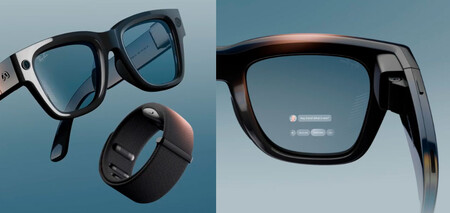
The first model, the Goal Ray-Ban Display , is touted as the most advanced in Meta’s offerings. It addresses a key issue that previous smart glasses faced by incorporating visual information directly into the user’s field of vision. The Ray-Ban Display comes equipped with an interior screen situated in the right lens, allowing users to see information like maps for navigation, video calls, and even real-time translations. This level of integration places these glasses at the forefront of wearable tech.
Additionally, they come with a unique feature called the neural bracelet . Utilizing electromyography , this bracelet translates muscle activity into actionable commands. For instance, a simple pinch gesture with the thumb and index finger can simulate mouse-clicking, while a pinch with the thumb and middle finger will navigate backward within applications.

Currently, the Ray-Ban Display will only be available in the United States for $799 , with a very limited release expected in early 2026 for other regions. However, whether Spain will be part of the rollout remains uncertain.
Ray-Ban Meta 2nd Generation

The second offering, Ray-Ban Meta 2nd Generation , is the successor to the original model. While maintaining the classic designs of Wayfarer and Skyler , it introduces a new option: the Headliner model . This generation presents significant upgrades, including a camera that can now record in 3K resolution , along with a battery that lasts twice as long—up to 8 hours on a single charge.
However, these improvements impact the price; while the first generation launched at €329 , the new model starts at €419 .
Oakley Meta Vanguard

Next is the Oakley Meta Vanguard , which follows the Oakley Meta HSTN . While the previous model had a blend of sports and lifestyle aesthetics, the Meta Vanguard opts for a more aggressive design that caters to sports enthusiasts. Different color options are available; however, it lacks the flexibility for prescription lenses.
This model features a 12 megapixel panoramic camera capable of recording 3K video at 30 frames per second or FullHD at 60 frames per second. The audio system has also been enhanced. The speakers are optimized to deliver clear sound even in windy conditions. With a battery life of up to 9 hours and a charging case that extends it to 36 hours , it makes for a robust choice for athletes.
On the downside, the price is relatively high at €549 , a notable increase from the previous €439 for the Oakley Meta HSTN.
Meta Smart Glasses Specifications
To provide a comprehensive overview, below is a table summarizing the key specifications for the smart glasses in Meta’s catalog, including the older models for comparison:
Ray-Ban Meta 1st Gen | Ray-Ban Meta 2nd Gen | Goal Ray-Ban Display | Oakley Meta HSTN | Oakley Meta Vanguard | |
|---|---|---|---|---|---|
Weight | Glasses: 48g standard, 50g large | Glasses: 51g standard, 53g large | Glasses: 69g standard, 70g large | Glasses: 53g | Glasses: 67g |
Crystals Supported | Various tints for Sun | Various tints for Sun | Various tints for Sun | Prizm | Prizm |
Audio | Double speakers (76.1db) | Double speakers (76.1db) | Double speakers (76.1db) | Double speakers (76.1db) | Double speakers (82.1db) |
Camera | 12MP ultra-wide | 12MP ultra-wide | 12MP ultra-wide | 12MP ultra-wide | |
Autonomy | 4 hours | 8 hours | 6 hours | 8 hours | 9 hours |
Memory | 32 GB | 32 GB | 32 GB | 32 GB | 32 GB |
Others | IPX4 resistance | IPX4 resistance | IPX4 resistance | IPX4 resistance | IP67 resistance |
Price | From €329 | From €419 | From $700 (limited) | From €439 | From €549 |
As we look to the future of wearable technology , Meta’s ambitious plans demonstrate a significant shift. Their innovations are not just about keeping up with current technology but also redefining how we interact with the digital world through wearable devices. The combination of practicality and advanced features could possibly pave the way for a new era in personal technology.