
Postponement of Key Testimonies in Historical Case
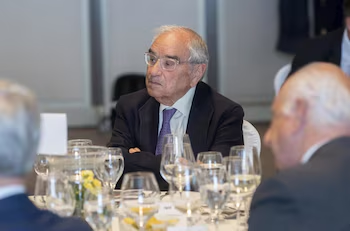
The Court of Instance No. 1 in Elda (Alicante) has recently announced that the testimonies of Daniel Aroca del Rey, a member of the Armed Police, and former minister Rodolfo Martín Villa—both implicated in the death of Teófilo del Valle in 1976—have been postponed. Originally scheduled for November 17 and 19, 2025, these important hearings have now been rescheduled to February 4, 2026.
Reasons Behind the Postponement
The court cited “logistical problems” as the primary reason for this delay. Both Aroca del Rey and Martín Villa were expected to appear via videoconference from their respective locations, which were planned to take place in the courts of Albacete and Madrid. The notification of the postponement was communicated to the involved parties in person last Friday, as reported by the State Coordinator of Support for the Argentine Complaint (Ceaqua).
Judicial Developments
This postponement comes amidst ongoing legal developments related to the case. The Court of Instance has rejected an appeal filed by Martín Villa challenging the admission of a complaint submitted by Teófilo del Valle’s brother, José Antonio del Valle Pérez. Notably, the Prosecutor’s Office has opposed this appeal, signaling a united front in support of the ongoing investigation. The delegate prosecutor for Human Rights and Democratic Memory has expressed a clear stance against the former minister’s appeal, which aligns with broader legal principles.
Significance of the Case
Ceaqua has praised the judicial decision to keep the case active, highlighting its importance under the current Democratic Memory Law and international human rights standards. The ongoing legal proceedings concerning this 1976 incident are part of broader efforts to address historical injustices and bring accountability.
Reactions from the Involved Parties
José Antonio del Valle, the brother of the deceased, has publicly stated his support for the rescheduling of the hearings, despite his preference for the original dates. His willingness to accept the judge’s resolution indicates a commitment to seeking justice for his brother’s untimely death.
Meanwhile, Ceaqua has expressed optimism regarding the continued progress of the case against Martín Villa and Aroca del Rey. They hope that the rescheduled testimonies in February will propel the investigation forward, ultimately leading to the establishment of judicial truth and accountability.
Conclusion
The postponement of these testimonies marks a crucial moment in a long-standing quest for justice related to human rights abuses during Spain’s Franco era. As the February 2026 date approaches, all eyes will be on how this case unfolds and whether it can provide closure for the victims’ families and contribute to a more comprehensive understanding of Spain’s historical narrative. The unfolding events underscore the importance of accountability and the role of the legal system in addressing past grievances.