
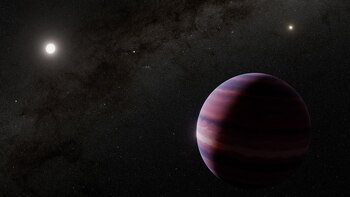
The possibility of existing a planet in the habitable zone of the closest stellar system to Earth has gained new traction thanks to a significant finding made with the James Webb Space Telescope. In a major stride for the field of exoplanet research, astronomers from the California Institute of Technology (Caltech) and NASA have identified compelling evidence of a giant gas planet orbiting Alpha Centauri A, one of two sun-like stars in the Alpha Centauri system, located merely 4 light years from our planet, as reported by Phys.org.
This groundbreaking discovery, featured in two papers awaiting publication, stems from observations conducted in August 2024 using the Mid-Infrared Instrument (MIRI) of the James Webb telescope. The research team, led by Aniket Sanghi and Charles Beichman, detected signs of a potential planet in the region commonly referred to as the habitable zone, where conditions are theoretically favorable for the existence of liquid water on a planet’s surface. This remarkable feat marks the first time a direct image of a planetary candidate in the habitable zone around a star so akin to our Earth’s sun has been obtained.
The identified planet is not rocky like Earth; rather, it is a gaseous giant estimated to be similar in mass to Saturn. Preliminary data indicates that it orbits Alpha Centauri A in an elliptical path, approximately two astronomical units away—twice the distance between Earth and the sun. While this orbit places the planet within the habitable zone of the star, scientists caution that, due to its gaseous nature, it is unlikely to support life as we know it. Furthermore, the presence of such a massive planet could inhibit the formation of smaller, rocky worlds in the same vicinity.
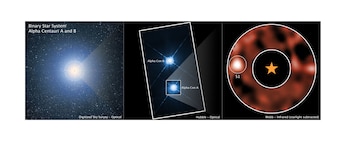
Acquiring this groundbreaking evidence necessitated overcoming substantial technical hurdles. The Alpha Centauri system comprises two luminous stars, Alpha Centauri A and Alpha Centauri B, whose combined brightness complicates the detection of dimmer objects. To counter this challenge, the research team employed a coronographic mask within the MIRI instrument, specifically designed to block the stellar light and facilitate the direct observation of fainter celestial bodies. Then, they applied advanced techniques to subtract the brightness of both stars, unveiling an object with luminosity more than 10,000 times fainter than Alpha Centauri A.
Charles Beichman, Executive Director of the NASA Exoplanet Science Institute at Caltech, underscored the significant technical complexity of these observations: “These observations are exceptionally challenging, even with the world’s most powerful space telescope, due to the bright stars’ proximity and their rapid movement across the sky.” He noted that the Alpha Centauri system’s proximity facilitates acquiring direct images of planets close to their host stars, unlike more distant systems such as Tau Ceti.
Aniket Sanghi, co-author of the study, emphasized the implications of this finding: “If confirmed, the potential planet observed in the Webb image of Alpha Centauri would represent a significant milestone in our efforts to directly capture images of exoplanets.” This candidate planet would be the closest ever imaged around its host star and the most closely aligned in temperature and age to the gaseous giants in our solar system.

Even though the evidence is compelling, researchers caution that the existence of the planet has not yet been confirmed. Follow-up observations with the Webb Telescope did not manage to detect the signal again, which, according to team simulations, might be attributed to the planet being too close to the star at that time. The scientists intend to pursue further observations with both the James Webb and the future Nancy Grace Roman Space Telescope, slated for launch in May 2027, to gather more data that could either verify or eliminate the existence of the planet.
This discovery bears significant implications for the hunt for exoplanets and the study of planetary formation within binary systems. To date, three exoplanets have been confirmed in the orbit of Proxima Centauri, the third star of the Alpha Centauri system, but no planets have been detected surrounding its sun-like stars. The likelihood of a gaseous giant within the habitable zone of Alpha Centauri raises fresh inquiries about planet formation and survival in intricate star environments. The presence of such a planet in a binary star system challenges current theories surrounding planetary development and evolution in chaotic settings and could profoundly reshape scientific understanding of processes leading to the formation of worlds beyond our solar system.