
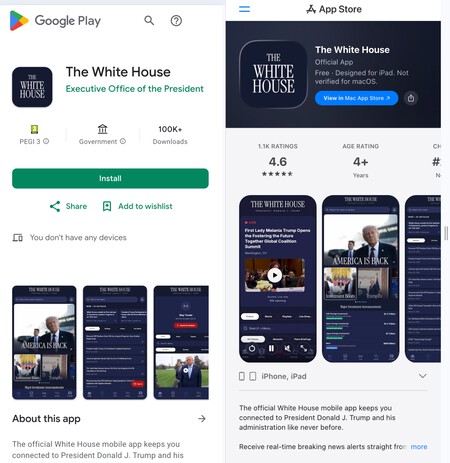
Donald Trump’s Administration recently released a new official White House app for iPhone and Android. At first glance, the concept of a government app designed to deliver statements, alerts, and institutional information seems ordinary. However, this app has sparked controversy, primarily due to its mandatory installation on official federal employee cell phones. Reports have surfaced indicating that federal employees from various agencies, including the Department of Agriculture and the Department of State, have had this app automatically installed on their devices, only for it to reappear after being deleted. Several workers, as reported by WIRED, expressed frustration over this persistent issue.
A Public App on Official Mobile Phones
The app, marketed by the White House as a means to receive “real-time updates, live events, and direct access to the Presidency,” does not appear to be an internal tool for public employees. As noted by WIRED, it seems to be the same version available to the public on Apple’s App Store and Google Play. The app contains a social section featuring messages from Trump on Truth Social and videos from platforms like TikTok and Instagram, as well as a news section with official statements and selected articles from various media outlets.
Employee Reactions
The contents of the app have led some employees to characterize the situation more seriously than merely a technical inconvenience. One USDA worker encapsulated the sentiment succinctly: “They are injecting pure and simple propaganda directly into our veins.” This sentiment indicates that for many employees, the app’s presence goes beyond a simple communication tool; it is viewed as an extension of the Administration’s political message, which raises ethical concerns about the intersection of public service and political propaganda.
The White House’s Justification
In response to the backlash, the White House defended the app, emphasizing its utility and security features. Spokesperson Olivia Wales stated that the app “does not require anyone to create an account or enter data,” asserting that the information within the app is “secure.” She also mentioned that government devices often come pre-installed with applications deemed valuable for employees.
International Context
This situation is not isolated; it resonates with other global attempts to mandate government applications on mobile phones. A noteworthy example occurred in India, where the government retracted the compulsory pre-installation of a public anti-fraud app called Sanchar Saathi. Similarly, in Russia, a state-backed messaging app was required to be pre-installed. However, these cases primarily focused on consumer markets, while the U.S. issue revolves around official work devices.
The Broader Implications
The core question is not merely whether the White House has the authority to manage the official cell phones issued to employees. Rather, it concerns the ethical implications of this power—specifically, the placement of a public political communication app on those devices. Federal employees have personal beliefs and political preferences, but their role should not involve accommodating political messaging through an official tool. The employee protests reported by WIRED represent more than a complaint about an unsolicited app; they reflect a broader rejection of blending governmental duties with political propaganda.