

The Ongoing Impact of Drones: An Incident in Estonia
The ongoing Ukraine War has not only transformed traditional combat strategies but has also highlighted the role of advanced technologies, especially drones. We have witnessed drones deploying drones, drone swarms engaging in aerial dogfights, and even autonomous drones utilizing AI. However, a recent incident has demonstrated a new dimension of this conflict: a Ukrainian drone strayed off course and ended up in a neighboring country.
A Drone in Estonia—About 80 kilometers from the Russian border, a farmer in Estonia discovered remnants of a Ukrainian drone that malfunctioned and exploded in his field, fortunately without causing injuries or significant damage. According to reports from the Estonian internal security , it is believed the drone aimed to attack Russian facilities near St. Petersburg but was diverted due to Russia’s intensive electronic warfare tactics, including GPS jamming. This incident marks the first known intrusion of a Ukrainian drone into a non-warring country since the conflict began in 2022, raising questions about the fragility of European air borders amidst ongoing technological warfare.
Electromagnetic Vulnerabilities—Margo Palloson, the director of the Estonian Security Service, explained that the drone deviated from its intended flight path at night, largely due to Russian countermeasures like GPS spoofing and jamming . Defense Minister Hanno Pevkur emphasized that such incidents are not isolated; Ukrainian drones have also crashed in neighboring Lithuania and Latvia . On the same day as the incident in Estonia, another drone fell on the Russian side of Lake Peipus , illustrating the extent of the conflict’s spillover into civilian airspace. Russia’s transformation of its borders into a wall of electronic interference poses significant risks to both military and civil aviation.
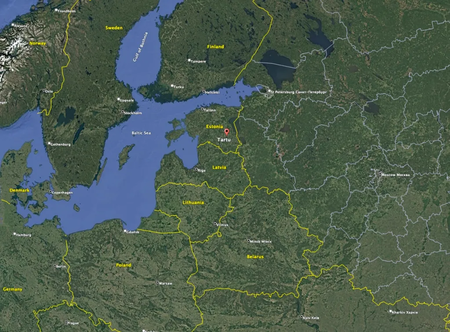
The Ukrainian drone was found about 80 km within the Estonian territory
Escalating Tensions in the Baltic Region—On the same day, Ukrainian forces targeted the Novatek Gas Complex in UST-Luga, Russia’s largest liquefied gas producer, located just 30 kilometers from Estonia. The images of the explosions signaled Kyiv’s increasing capability to strike critical infrastructure within Russia. This geographical proximity has made Estonia and its Baltic neighbors involuntary witnesses to the escalating risks of drone warfare, leading to a rise in incidents similar to those occurring in Poland , Romania , and Moldova .
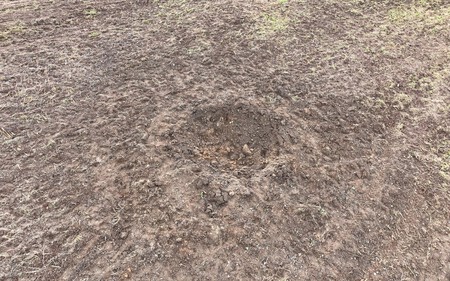
Drone impact on Estonia
Enhanced Detection Capabilities Needed—Estonian authorities have acknowledged the urgent necessity to bolster detection technologies for low-flying drones, which often evade radar systems. Prime Minister Kristen Michal suggested implementing a layered defense system, yet experts warn that achieving absolute coverage is unfeasible. Meanwhile, countries like Poland are investing in balloon-mounted radars capable of detecting both drones and low-flying cruise missiles, though maintaining constant aerial preparedness remains a financially burdensome endeavor.
Concerns in Poland—The drone incident in Estonia coincided with another recent event where a Russian military drone , equipped with a Chinese engine, reportedly crashed in a cornfield near Osiny, southeast of Warsaw. Poland has officially recalled that Russia tends not to acknowledge such occurrences, while several NATO countries have experienced similar incidents. The increased number of drone-related events has compelled NATO fighters to remain on high alert to safeguard the alliance’s airspace.
Impacts on Civil Aviation—The diversion of a Ukrainian drone has had ripple effects on civil air traffic as well. A passenger flight from Sharm el Sheikh to St. Petersburg had to make an emergency landing in Estonia after Pulkovo airport temporarily closed due to drone activity. The International Civil Aviation Organization has deemed Russian GPS interference in the Baltics a serious threat, impacting not only military operations but also civilian flights throughout the region.

A Dangerous Competition—The backdrop of this incident illustrates the frantic race between Russia and Ukraine to deploy long-range weaponry. Ukraine is developing advanced drones and missiles, such as the Flamingo land cruise missile , which boasts a range of 3,000 kilometers, potentially altering the dynamics of the conflict significantly. Concurrently, Russia has been enhancing its own capabilities, focusing on more sophisticated and substantial drones and missiles. This competition raises the likelihood of misfires extending beyond the active combat zones, increasing the risk of unintended conflicts involving NATO countries.
The drone incident in Estonia serves as a microcosm of the evolving dynamics in modern warfare, emphasizing the need for nations to prepare for the complexities introduced by advanced technology in military conflicts.