
| IN BRIEF |
|
Recent discoveries in South Africa shed light on the ingenuity of prehistoric cultures. These stone tools, uncovered in an once-inaccessible site, not only reveal the survival of our ancestors but also their capacity to organize complex social networks . These artifacts bear witness to a collective memory and an advanced technical culture that predates the earliest pages of written history. The meticulous excavation of the KEH-1 cave has unveiled an archaeological wealth that redefines our understanding of prehistory.
The KEH-1 Cave: A Unique Archaeological Site
Nestled 75 meters above the current sea level, the KEH-1 cave dominates the South African coast. During the Ice Age, it overlooked a vast plain, providing an unobstructed view of a landscape now lost to time. It is in this exceptional setting that Sara Watson’s team from the Field Museum of Chicago initiated their research. The cave’s difficult access, requiring harnesses and makeshift staircases, posed a significant obstacle. However, this isolation also protected the remains from weathering and erosion, preserving sedimentary layers virtually intact for millennia.
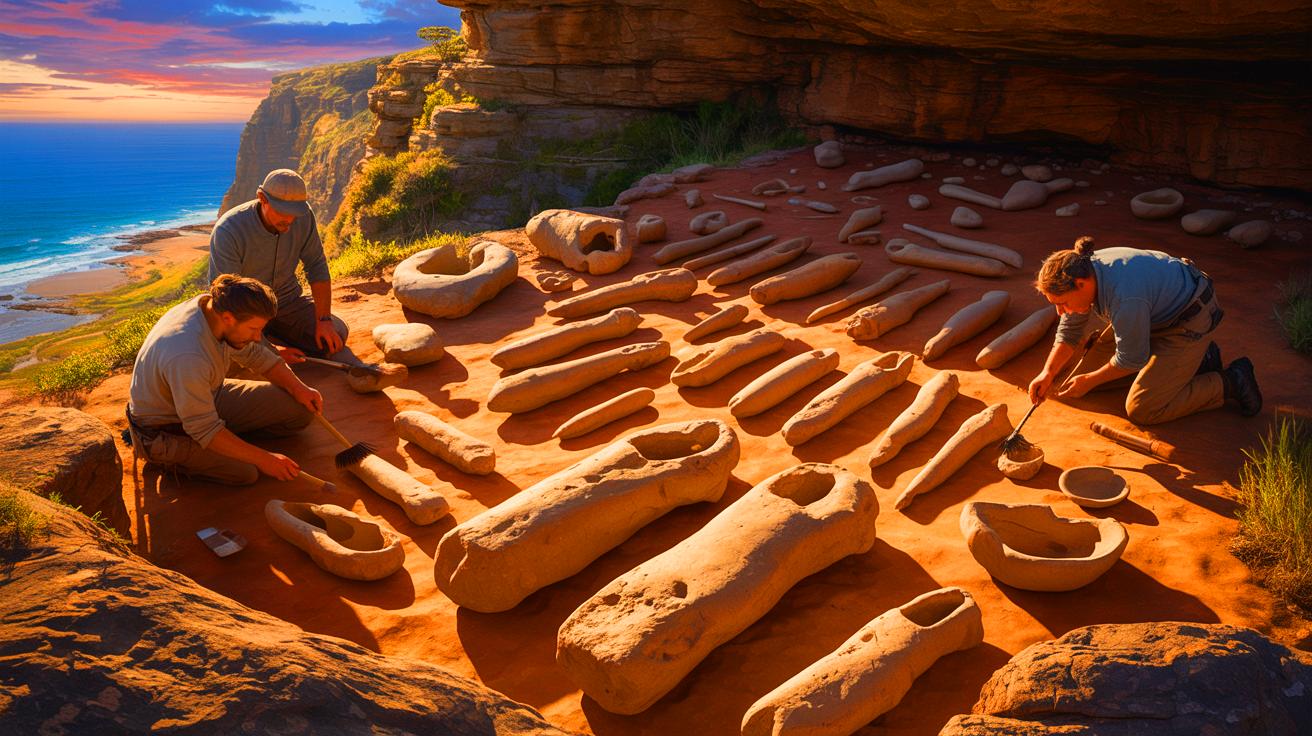
The team’s efforts led to the discovery of an exceptional lithic assemblage composed of diverse stone tools. These artifacts, meticulously aligned post-extraction, demonstrate a vast range of shapes and functions, showcasing the craftsmanship of the ancient inhabitants of the region. The stability of the site has thus provided a unique window into a distant past, enabling the study of a culture adept at adapting to ever-changing environments.
Prehistoric Tools: Testaments to a Sophisticated Culture
The artifacts uncovered at KEH-1 are associated with the Robberg technocomplex , a well-documented culture in southern Africa. This cultural complex, active between 26,000 and 12,000 years ago, is characterized by the production of small blades crafted with remarkable precision. These blades, analyzed by Sara Watson and her team, exhibit a standardization of techniques and an impressive technical mastery.
Likely intended as points in composite weapons, these blades were essential for long-distance hunting in open environments. Their sophisticated manufacturing underscores a technical and environmental adaptability , highlighting the ingenuity of these prehistoric peoples. Beyond their immediate usefulness, these tools reflect a profound understanding of materials and techniques, along with a commitment to refining their methods.
A Broad Transmission of Knowledge
The stone tools from KEH-1 unveil unexpected social dynamics. When compared to those from other southern African sites, the artifacts display striking similarities, indicating the dissemination of techniques across vast distances. The knapping methods employed at KEH-1 have been observed as far away as Namibia and Lesotho.
This technical consistency suggests a conscious transmission of skills, facilitated by cultural exchanges between distant groups. While adhering to the main characteristics of the Robberg technocomplex, the tools from KEH-1 exhibit unique traits, such as slightly larger sizes and less frequent use of bipolar percussion. These differences point to a temporary use of the site, likely as a hunting camp. This transient character reinforces the idea of a circulating network of ideas, where each site contributed to a technical diversity while sharing a common foundation.
A Cultural and Technical Legacy
The artifacts discovered are not merely utilitarian objects. They represent the memory of a transmission of gestures and knowledge across generations. By tracing their history, archaeologists illuminate a humanity capable of cooperation and exchange over long distances. Sara Watson emphasizes that these Paleolithic populations shared our ability to adapt and innovate, illustrating a complex communication network existing long before writing emerged.
These discoveries compel us to rethink our cultural and technical legacy. What do these tools say about the social organization of these peoples? How have they influenced subsequent cultures? These questions remain open and fuel our fascination with a past that continually reveals its secrets.
The author utilized artificial intelligence to enrich this article.
Did you like it? 4.5/5 (22)