

The Swiss National Bank’s Transformation: A Shift in Investment Strategy
The Swiss National Bank (SNB) , once a paragon of conservative fiscal management, has entered uncharted waters. In recent times, it has emerged as a formidable technological investor , accumulating a stock portfolio that rivals nearly one-fifth of Switzerland’s annual economic output.
Understanding the Current Landscape of SNB’s Investments
Recent reports from the US Securities and Exchange Commission (SEC) indicate that the SNB now holds approximately $167 billion in equities from US firms, spread across more than 2,300 positions . This significant investment makes SNB one of the primary investors in the technology hub of Silicon Valley .
Focusing on Major Tech Giants
Of this extensive portfolio, more than $42 billion is strategically invested in just five tech titans: Amazon, Apple, Meta, Microsoft, and Nvidia . Among these, SNB has channelled nearly $10 billion into Apple and over $11 billion into Nvidia , showcasing a focused interest in these industry giants.
A Unique Financial Institution
Though not a sovereign wealth fund per se, the Swiss National Bank boasts an asset balance of $855 billion , placing it next to major sovereign investment vehicles from nations like Singapore or Qatar . Experts believe that while the SNB’s portfolio may resemble that of an investment fund, its primary focus remains on currency management rather than exerting influence over the companies it invests in.
Comparative Approaches: SNB versus Other Major Banks
The SNB’s unconventional strategy sets it apart from other central banks. For example, the Bank of Japan relies on methods like exchange-traded funds (ETFs) and primarily invests within its own economy. By contrast, there are calls within Switzerland for the SNB to adopt a more active investment stance, akin to a dedicated fund. Meanwhile, the European Central Bank has raised concerns about overvaluation in the stock market, highlighting the diverse strategies employed by different central banks.
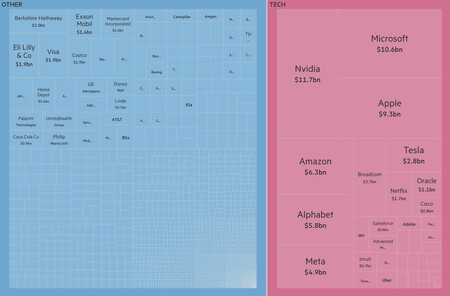
<span>SNB positions in US companies. Source: Financial Times with SEC data.</span>Investing Strategically Amidst Global Challenges
Switzerland’s domestic bond market is too limited for SNB’s expansive operations, prompting the bank to invest acquired foreign currencies—predominantly dollars and euros —into bonds and stocks abroad. This approach, dubbed “Foreign Quantitative Flexibility ,” has resulted in substantial investments in US tech companies.
The backbone of this strategy lies in the strength of the Swiss Franc , which is revered as a global safe-haven currency. However, an excessively robust Franc can hinder exports and induce deflation, making Swiss goods pricey for foreign buyers. To mitigate these impacts, SNB engages in the opposite behavior of traditional investors: it sells Francs, thereby increasing supply, and uses the proceeds to invest in companies like Apple and Nvidia.
Passive Yet Adaptive: SNB’s Investment Philosophy
While the SNB maintains a passive investment philosophy and does not typically exercise voting rights in the companies it invests in, recent data from the SEC indicates adjustments in its positions. There has been a notable increase in holdings of Nvidia as well as a new investment in Berkshire Hathaway , while simultaneously trimming its investments in Meta and Netflix . Such adjustments carry risks, but the SNB appears to be navigating these transitions effectively.
In a rapidly changing global economic landscape, the Swiss National Bank’s shift from traditional conservatism to a more active investment role demonstrates its unique adaptation strategy. The balance between managing the currency and exploring profitable ventures outside of Switzerland reflects a nuanced understanding of both domestic and international financial dynamics.