
China is the name that comes to mind when talking about megaconstructions . The country has faced some of the most complex works of recent years and boasts pharaonic projects such as the largest dam in the world and the most complicated tunnel. In this matter, Europe is not far behind, with two notable projects aimed at becoming the longest tunnels in the world in different fields: the largest submerged tunnel, covering 120 kilometers , and the world’s longest rail tunnel, the Brennero Base Tunnel.
A 2006 project finally yielding results.
Brennero’s Base Tunnel is a monumental undertaking that has experienced numerous delays and changes in its estimated timeline and completion dates. Official construction began in 2007, yet the excavation did not commence until 2015 . This tunnel is part of the Scandinavia-Mediterranean European Corridor (or Scan-Med) and will connect the Munich-Verona axis. Its primary goal is to enhance communication among countries by overcoming a considerable natural barrier: the Alps .
This development is pivotal for improving the commercial and passenger railway networks in Europe , allowing trains to reduce reliance on airplanes as part of a larger decarbonization strategy. This will not only facilitate faster connections between Germany and Italy but also transfer much of the Alpine freight traffic from roads to rail. The resulting benefits include reduced traffic jams, lower CO₂ emissions, and a significant boost in logistics efficiency between northern and southern Europe .
<img alt="Italy's Colossal Build: The Messina Bridge" width="375" height="142" src="https://i.blogs.es/defd5c/puente-de-messina/375_142.jpeg"/>Colossal in scope, the Brennero Base Tunnel will span a total length of 64 kilometers . Once operational, it will officially be the longest railway tunnel globally. The main section connecting Fortezza in Italy and Innsbruck in Austria will measure about 55 kilometers , comprising two parallel tunnels with a single route each.
These will be interconnected every 333 meters through service tunnels, allowing for safe evacuation in emergencies. A unique feature of this tunnel is that it will be designed as a “flat” tunnel , remaining at approximately 794 meters above sea level throughout the journey. This design minimizes energy consumption, as current trains navigating through the Alps often require several locomotives due to steep inclines.
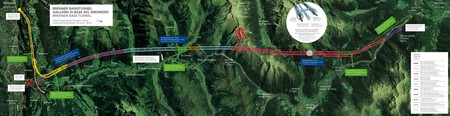
Beyond transportation, the plan also allows for the passage of freight trains weighing up to 3,000 tons , alongside passenger trains capable of operating at high speeds, up to 250 km/h . Presently, the average speed is around 50 km/h due to geographical constraints. Furthermore, another tunnel with a five-meter diameter will be situated a dozen meters below the main tunnels, serving as an exploratory channel for geological research as well as enabling groundwater drainage.
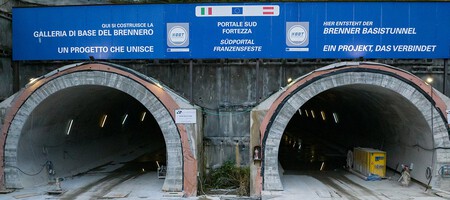
Current State and Next Steps. Initially, the Brennero project was expected to be completed by 2025 , but shifting circumstances have altered that timeline. The Alps pose significant challenges due to subterranean failures and water bodies, impacting excavation techniques and approaches to tunneling under rivers and the Isarco. Administrative delays, especially between Austria and Italy , have further complicated progress. The onset of the COVID-19 pandemic also stalled work.
Consequently, the initial budget of €6 billion has ballooned to about €8.4 billion . However, a green breakthrough occurred recently when advanced excavators like Flavia significantly expedited tunneling. On September 18 , Italian and Austrian excavation teams achieved a historical connection between the two countries.
While this milestone is commendable, substantial work remains in covering the tunnels, laying down rail infrastructure, and incorporating technical systems for ventilation and signaling.
<img alt="Modern Tunnel Construction Equipment" width="375" height="142" src="https://i.blogs.es/763bc1/xtk---plantilla-portada-dividida-3/375_142.jpeg"/>Piercing the Alps, the target completion date is set for 2032 , when the tunnel is expected to be operational for transporting goods and passengers. Notably, Brennero is not the only monumental project underway in the Alpine region ; several others, including the Mont Cenis tunnel, which will measure 57.5 kilometers and connect Lyon with Turin , and the San Giardardo base tunnel at 57.1 kilometers , linking the Swiss towns of Erstfeld and Bodio are also in progress.
Moreover, there are additional tunnels, such as Koralm (32 km), Semmering (27 km), Ceneri (14.5 km), and Lötschberg (34.6 km). The common objective across these projects is to facilitate transalpine transport , effectively reducing CO₂ emissions while expediting the movement of both passengers and freight. As these ambitious undertakings progress, the focus remains on meeting construction timelines and delivering on their promises.
Images | BBT-SE
In Xataka | Japan created an artificial peninsula to make an airport. You will soon have a submarine airport.