
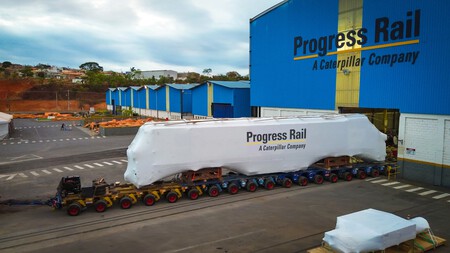
There are places where scale determines everything, and Port Hedland is one of them. In the northwest of Australia, a revolutionary locomotive is set to challenge the long-standing dominance of diesel engines in the mining sector. Progress Rail proudly introduces the world’s largest battery-powered electric locomotive, designed not just for display but for real-world mining applications. This move, if successful, could prompt significant changes in an industry resistant to transformation.
Transitioning from Diesel to Battery Power
The newly arrived locomotive in Western Australia, the EMD SD70J-BB, marks a notable shift in Australian mining. It features an advanced eight-axis architecture paired with a high-capacity battery capable of reaching 14.5 MWh. Weighing between 245 to 265 tons, the difference in weight may vary based on configuration, showcasing the complexity of modern locomotive design.
This locomotive’s journey began in Sete Lagoas, Brazil, demonstrating the logistical considerations uncommon for entire fleets. The individual shipment underscores a gradual approach to introducing this innovative technology into mining operations.
Battery Electric Locomotives: Operational Benefits
Fortescue labels these machines as Battery Electric Locomotives (BEL), harnessing technology commonly utilized in other electrical sectors. The system can recover 40% to 60% of energy during braking, critical for operations on inclined slopes. Such efficiencies could significantly reduce fossil fuel reliance, with Fortescue estimating that their electric locomotives could collectively cut down diesel consumption by about a million liters annually, contingent on operational scenarios.
Sound and Environmental Impact
Moreover, Progress Rail has achieved an operational noise level below 70 dB, setting a new standard for heavy rail. This reduction not only enhances comfort but also improves working conditions in typically noisy industrial environments, marking another advantage of electrification beyond just energy consumption.
Comparative Analysis with Traditional Diesel Locomotives
The main competition remains heavy-duty diesel locomotives. While these machines are known for their autonomy, electric alternatives like the SD70J-BB present new challenges, such as energy management and recharging logistics. Unlike hybrid models that combine combustion engines with batteries, this locomotive relies entirely on electric power, potentially simplifying maintenance while increasing dependence on energy infrastructure.
Corporate Vision and Future Prospects
The collaboration between Progress Rail and Fortescue is pivotal. Progress Rail, a Caterpillar subsidiary since 2006, aims to integrate sustainable solutions into high-demand environments while Fortescue works to minimize its ecological footprint, integrating these units into its broader decarbonization strategy.
The effectiveness of this initiative ultimately hinges on practical outcomes. The reliability, maintenance demands, and actual operational efficiencies of the locomotive will need rigorous testing under real load conditions to validate preliminary estimates and support broader industry adoption.