
Unveiling the Mysteries of Arbulo’s Church Paintings
When we think of a church, we often envision crosses , saints , and biblical scenes . However, the recent discovery in the Church of Arbulo in Álava , Spain, has unveiled a radically different narrative. Beneath layers of lime and paint , experts find astonishing imagery dating back to the 12th century —featuring quadrupeds with claws, bizarre birds, and enigmatic geometric shapes.
As researchers delve deeper, questions arise. What do these uncategorizable images signify in a Christian temple? What led the creators to paint such an array beneath the altar of a house of worship?
The Church of Arbulo: A Historical Gem
Located in the quaint municipality of Elburgo, the Church of Arbulo is dedicated to San Martín de Tours . Although much of the structure is rooted in the 15th and 16th centuries , remnants from a Romanesque building still exist. Over the years, the church fell into a state of disrepair , with leaks and wear taking a toll on its interior. Between 1999 and 2008, the church was closed for restoration to prevent further damage.
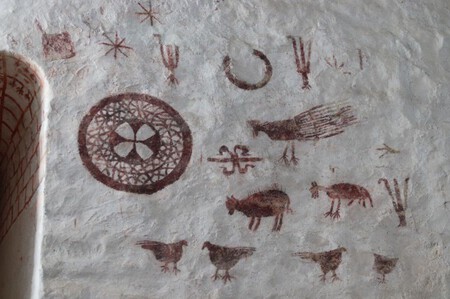
Following the restoration efforts initiated in 2004, historians began uncovering layers of ancient wall paintings. Historian Gorka López de Munain from the University of the Basque Country notes that moisture issues led to removing the altarpiece, thereby unveiling these intriguing murals.
Curious Imagery Found
Among the most striking discoveries were various geometric shapes and animal figures . López de Munain describes how the initial layer (dating between the 12th and 13th centuries ) revealed a wealth of symbolic artistry that diverges from typical Christian iconography. Instead of the usual representations of Christ, the Virgin Mary, or saints, the paintings showcased swine, wild boars, and other animals arranged in a seemingly random manner .
What raises eyebrows is the realization that such motifs do not fit the established repertoire of religious artwork typical of that time. The bizarre nature of these images compels historians to question their meaning and purpose in the context of a sacred space .
In a 2018 interview with eitb.eus , Isabel Mellén, a participant in the Medieval Álava project, commented, “What we hope to find in a church are religious paintings… what is shown in Arbulo has nothing to do with all that.” This perspective underscores the unexpected nature of these findings.
Artistic or Funeral? Theories on Meaning
Beyond the initial shock, researchers like López de Munain point to possible funeral connotations associated with these images. The presence of turkeys, common in medieval mortuary themes, indicates a deeper narrative. They often represented life and death cycles, common motifs found in tombstones and grave art .
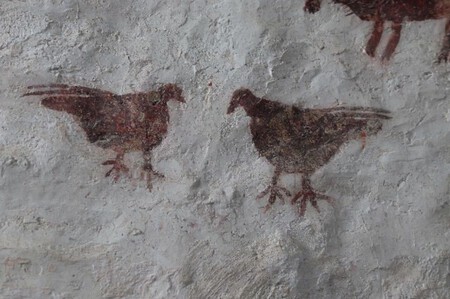
“The birds painted in Arbulu are evocative of recurrent themes in medieval funerary contexts,” says the historian. While identifying their exact nature remains elusive due to the absence of other symbolic icons, the notion of funeral art cannot be ruled out.
Exploring Broader Implications
The intricate wheels and geometric patterns unearthed in Arbulo further enhance the mystique of these finds. As noted by López de Munain, such designs frequently appear in medieval funerary steles, adding yet another layer of complexity to their interpretation.
The big question looms: why did the artists choose to depict animals, solar disks, and clawed quadrupeds in a Christian temple? This dichotomy between expected Christian iconography and the found imagery raises fascinating theoretical perspectives. Some suggest these figures were a reflection of the community’s local environment, while others speculate a desire to emulate symbols tied to prestige and Roman culture.
Broader Artistic Trends
The examples found at Arbulo are not isolated. Across Álava , and indeed Europe, there are other examples of such unconventional wall paintings, with many still waiting to be discovered and analyzed. The historical oversight of these artworks has led them to remain on the periphery of the artistic canon , but the images at Arbulo urge historians to re-examine these neglected legacies.
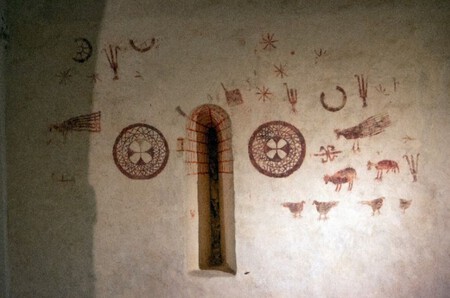
López de Munain highlights that these unattended works offer extraordinary potential for contemplation and understanding of the broader cultural significance of visual art in medieval times. With the increasing interest in the visual culture of history, such discoveries become invaluable for interpreting the layers of societal beliefs and practices from centuries past.
In conclusion, the imagery found within the Church of Arbulo prompts a necessary re-evaluation of what is often categorized as religious art. As we uncover these hidden narratives , we learn not only about the artistic directions of the medieval period but also about the complex relationship between spirituality and the broader cultural landscape.
General News – 2