
A few days ago, Nvidia achieved what many considered impossible: the US government’s decision to allow the sale of its GPU H200 to Chinese clients. This marks a significant shift in policy for the Trump administration, which had imposed stringent restrictions on tech exports to China since April. Despite the tough sanctions, investigations by the Financial Times indicate that loopholes exist in these controls.
What happened? According to the Financial Times , detailed examinations of sales contracts and corporate presentations reveal that three months after the Trump administration tightened export controls, chips valued at $1 billion were still sent to China. This figure is significant, particularly given that Nvidia reported revenues of $17 billion last year.
The process appears to have initiated in May, as Chinese distributors started marketing GPUs that fall under data center restrictions affecting Chinese AI laboratories. This investigation corroborates what the US authorities already suspected: many of these chips find their way into China through Southeast Asia.
They are not ordinary chips. The research indicates that Chinese AI companies are successfully acquiring the NVIDIA B200 GPU , which, though eclipsed by a successor, remains highly coveted for training models. It promises to quadruple the performance of the much-sought-after H100 in MLPerf 4.1 benchmarks.
The investigation also highlights the sale of other chips under export restraints, such as the B200, H100, and the H200. For context, a complete rack of eight B200 GPUs costs approximately $489,000 , a figure that has decreased since their arrival in China in May. This price markup contrasts sharply with the authorized sales, which carry an additional 50% premium.
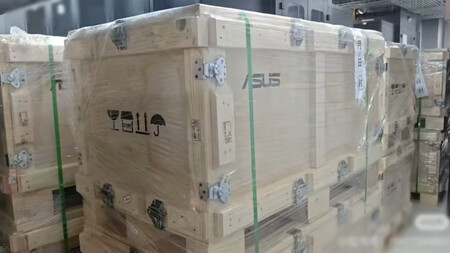
Publication on social networks announcing the sale of ASUS H200 racks. Image: Financial Times
Nvidia’s position. The company has consistently emphasized its commitment to maintaining a presence in China, attributing 13% of its global income to this market. Jensen Huang, Nvidia’s CEO, has praised Chinese AI models during challenging periods for the company, emphasizing the necessity of collaboration with Chinese firms amidst ongoing chip sales restrictions.
During a time of indecision for the US regarding tech sales to China, Huang has elevated the capabilities of solutions offered by Huawei to the level of the H200.

A path fraught with difficulties. As Nvidia pointed out to the Financial Times , clandestinely purchasing chips doesn’t yield the expected results. Constructing a data center equipped with GPUs involves more than just assembling parts; it necessitates service and support, which the company does not provide for chips sold outside of approved channels.
An operator of a data center noted that while export controls don’t outright prevent NVIDIA chips from reaching China, they do create inefficiencies and generate “huge profits for intermediaries taking risks.” Despite the challenges, a distributor acknowledged that there is currently “no shortage.”
The impact of the relaxation regarding the H200. Following the announcement permitting the marketing of the H200 in China, sales of the B200 and other black-market chips have reportedly decreased, according to several distributors. Although the reasons remain unclear, purchasing from Nvidia ensures the aforementioned support along with a more competitive price. Nonetheless, some Chinese distributors are still advertising stock of the B300, which has yet to be mass-produced.
Image | Nvidia and Flickr
As the tug-of-war over tech exports between the US and China continues, Nvidia remains at the crossroads, navigating the complexities while seeking to maintain its foothold in one of the world’s most lucrative markets.