
The Tartessian Civilization Unveiled in Guareña, Badajoz
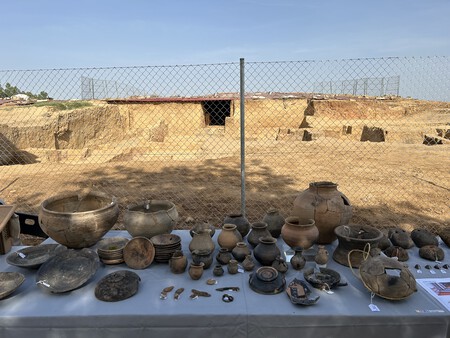
Guareña, a small town located in the Vega Altas del Guadiana region of Badajoz, has become a focal point of archaeological discovery. With a population of just over 6,600, this quiet town is home to a significant archaeological site known as the Casas de Turuñuelo. Although historians have long acknowledged its existence, it wasn’t until 2014, following initial surveys, that the extent of its treasures began to unfold.
Recent Discoveries at Casas de Turuñuelo
During an ongoing eighth excavation campaign, researchers have made a notable find: an altar shaped like a bull’s skin. This piece aligns with the distinct characteristics of Tartessian culture, renowned for its rich historical significance. Discovered in a hallway adjoining ‘room 100’, the altar not only bears inscriptions but also contains ashes from previously sacrificed animals—a telling indication of the site’s ceremonial practices.
Importance of the Findings
The recent unearthed altar provides invaluable insights into the structure and complexity of the Casas del Turuñuelo site. It serves as a testament to the archaeological wealth and contributes significantly to our understanding of the Tartessians, a civilization that thrived in what are now the provinces of Huelva, Seville, Cádiz, and Badajoz between the 9th and 5th centuries BC. Such findings affirm Guareña’s relevance in the context of Iberian history, elevating its status as a site of immense archaeological importance.
Highlighting this significance, the Guareña City Council emphasizes that the site offers a glimpse into a key aspect of Tartessian culture, particularly its artistic expressions, as evidenced by the first reliefs of human faces discovered in this region. This challenges earlier assumptions about Tartessian art being predominantly aniconic.
A Treasure Trove of Findings
Since exploration initiatives began in 2014, the site has consistently produced remarkable artifacts, prompting the Institute of Archeology (CSIC-Junta de Extremadura) to advocate for the formation of specialized work teams. The first three campaigns uncovered parts of a majestic two-story building, complete with a courtyard and three distinct rooms.
Among the recent discoveries include:
- Sacrificial Remains: Bones from at least 52 horses, four cows, four pigs, and a dog, indicating the site’s involvement in ritual animal sacrifices.
- Artisan Objects: Bronze weights, unguent jars, tableware, and remnants of a Greek sculpture, showcasing trade and cultural exchanges.
- Architectural Features: Unique stairs made from lime mortar ashlars, recognized as one of the oldest examples in the Iberian Peninsula for “anthropic lime production.”
The Search for More
The overarching question now remains: what other treasures could still be hidden beneath the layers of earth at Casas de Turuñuelo? The site continues to reveal secrets, including combat scene engravings, ancient alphabets, and the oldest known Greek marble altar in the western Mediterranean.
As archaeologists delve deeper, the significance of Guareña and its Tartessian heritage becomes ever more apparent. With each campaign, it not only enriches our understanding of an enigmatic civilization but also contributes to the collective narrative of human history in the Iberian Peninsula.
Conclusion
The ongoing excavations at Casas de Turuñuelo are a reminder of the historical wealth contained within the Spanish landscape. As each layer is peeled away, the mysteries of the Tartessian civilization are gradually uncovered, and Guareña stands as a beacon of archaeological revelation. The future holds exciting possibilities as researchers continue to explore this treasure trove of history.