
## The Surge of the Space Race
All powers have embarked on the new space race, with Artemis II serving as a beacon of ambition, igniting interest in sending humans beyond our borders. While humanity has one of the most exclusive laboratories in low orbit—the International Space Station (ISS)—this facility is now nearing its end. China has sent a clear message with its Tiangong space station: soon, it will expand to become twice as big.
## China’s Space Ambitions
### A Journey Begins
China’s foray into space began after it was excluded from the ISS project. Unfazed, the country launched its own space station initiative, Tiangong, which first saw its central module launched into low orbit in 2021. This structure was designed to allow Chinese astronauts to conduct experiments in an environment previously denied to them.
### Current Limitations
Despite its progress, the Tiangong station has been limited in size. Currently, it has a mass of just 100 tons and offers a pressurized volume of 340 m³, accommodating up to three astronauts at a time. This is significantly smaller compared to the ISS, which weighs over 420 tons and can support a crew of seven.
## Expanding Horizons: The Future of Tiangong
### Plans for Expansion
Recognizing the need to enhance its capabilities, China has announced plans to expand Tiangong. According to state television CCTV, the station will transform from a ‘T’-shaped structure with three modules to a more complex cross-shaped design featuring six modules.
### Projected Growth
Following this expansion, the mass of Tiangong is expected to rise to around 180 tons. While it will still lag behind the ISS in capacity, it will accommodate six astronauts on permanent missions. The upgraded station will feature a fourth module with multiple docking ports, allowing for the addition of future laboratory units. Construction is slated to begin around 2027, supported by a Long March 5B rocket designated for transport.
## Exclusivity and Global Cooperation
### An Exclusive Laboratory
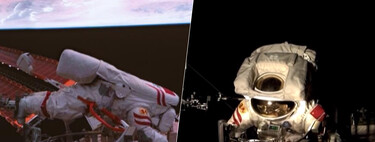
Currently, Tiangong stands as an exclusive laboratory for Chinese researchers, having hosted over 260 experiments and numerous spacewalks. However, circumstances may change if it becomes the only manned space station in low Earth orbit. With an increasing focus on international collaboration, China holds the keys to access, potentially allowing foreign astronauts to conduct experiments onboard.
### International Collaborations
Recently, the Chinese Manned Space Flight Agency announced plans to train two Pakistan Air Force pilots as reserve astronauts, one of whom will travel to Tiangong—the first non-Chinese astronaut to do so. This move reflects China’s intention to engage with the United Nations Office for Outer Space Affairs to promote cooperative efforts in space exploration.
## The Future of the ISS
### An Uncertain Fate
As China eagerly advances its space program, the future of the ISS remains uncertain. Scheduled for dismantlement in 2031, the ISS may face decommissioning through a NASA-led plan that employs a SpaceX vehicle to guide it to a designated space cemetery in the Pacific.
### Global Considerations
With ongoing discussions about the ISS’s fate, whether to dismantle or repurpose it, there’s a distinct possibility that soon, Tiangong might emerge as the sole manned space station in low Earth orbit—boldly signaling a new era in space exploration.