
Xie states that what has lived in recent days has been a terrible déjà vu. This thirty-year-old businessman, more than fear of viral disease that he has been giving up for his neighborhood, what she has felt is panic for the echoes that accompanied her: military disinfecting the streets, quarantines in hospitals, officials by force into apartments to fumigate and take blood samples, speakers everywhere repeating alarming messages in an alarming loop.
“Five years ago, two neighbors who work as volunteers in the neighborhood committee gave me masks. In early August, the same two neighbors called me to distribute mosquito nets,” Xie explains from her neighborhood on the outskirts of Foshan, one of the large manufacturing centers in southern China, which has been under check for the entire summer by mosquitoes that are transmitting a painful viral disease that has already infected around 8,000 people in the Asian country.
Chikungunya is how the disease is caused by a virus of the same name. To fight it, Chinese officials have resorted to the old manual that guided the dreaded during the pandemic National Policy known as “Covid Zero.” At times, as Xie points out, some flashes of those extreme measures have reappeared in a country that still drags many traumas of the three years that more than 1.4 billion people passed under the yoke of restrictions that lasted too long.
“Officials fumigating streets, forcibly entering houses to collect samples, quarantines… The vast majority have continued to lead a normal life, but there have been moments that have been like reliving a nightmare with the alerts that came to us everywhere,” says Yang, another neighbor of Foshan.
New Deployment Against Virus: Drones and Giant Mosquitoes
The authorities of this city deployed last week drones to identify more precisely from the air where the farms of the infected mosquitoes were. “These drones have taken aerial photographs panoramic in more than 170 sites, providing high-resolution images that guide the sanitation equipment precisely,” local officials stated.
Scientists also mobilized to release giant elephant mosquitoes, a species whose larvae feed on virus bearers, while in the ponds of this city, home to more than nine and a half million inhabitants, more than 5,000 devouring insects were released.
In the government channels of Wechat, China’s equivalent of WhatsApp, experts from the Centers for Disease Control and Prevention continuously informed that the Chikungunya is transmitted by the bite of infected mosquitoes and not directly from person to person; causing mild symptoms, especially fever, fatigue, and muscle pain, and that it is rarely fatal. However, this information made many residents of southern China not understand that both in Foshan—where they raised their public health emergency response to level 3, the second lowest in a four-level system—and in other affected cities in the province of Guangdong, alarms and extreme measures of pandemic times were resurrected.
There have been episodes of basic rights violations of citizens due to forced interference in homes. The case that most enraged the social mass was experienced in the Zhanjiang port city. A single mother uploaded a video to Weibo, equivalent in China to Twitter, showing uniformed police entering at night into her two children’s room to extract blood samples from the little ones while they slept.
They were employees of a pharmacy from the neighborhood who warned the authorities that the woman had bought fever medications because one of her children was sick. When agents and officials appeared at her home in the morning to test the children, the mother refused and did not open the door. Hours later, taking advantage of her night shift and the fact that the children were alone and sleeping, the police forcibly entered the home to extract samples from the minors. The entire scene was captured by the camera that the mother had in her children’s room.
“Officials fumigating streets, forcibly entering houses to collect samples, quarantines… There have been moments that have been like reliving a nightmare,”
In many neighborhoods, community workers have also appeared calling door-to-door to inspect houses and verify that residents do not accumulate containers with water, which attract infected mosquitoes. The authorities have warned that anyone who refuses to cooperate can face a fine of 10,000 yuan (around 1,200 euros) or even criminal charges for “obstructing the prevention of infectious diseases.”
Local media reported that residents of five buildings suffered electricity cuts as punishment for refusing to collaborate. Both in Foshan and other affected cities of Guangdong, quarantined rooms have been temporarily established within hospitals where infected individuals are sent, enclosed inside rooms covered by mosquito nets. This virus propagation policy has been applied in China since the 2003 Sars outbreak.
In the pharmacies, as was the case during COVID-19, employees received orders to track customers buying medications for fever, rashes, or muscle aches. Many Foshan skyscrapers illuminated every night with messages reminding residents of prevention measures. “It is required that companies, factories, and residential complexes conduct large-scale sanitation campaigns. Efforts should focus on garbage cleaning and debris waste collection points in underground parking, alleys, green areas, and shrubs. All homes must empty water from pots and bottles without use,” they indicated.
Neighborhood committee volunteers have been distributing mosquito nets and anti-mite solutions in residential areas. In Foshan, the majority of infections have been reported, but more than 200 cases have also emerged in a radius of 160 kilometers from the epicenter of the outbreak, in a dozen areas of Guangdong, Hong Kong, and Macao.
“Everything is under control,” the Authorities Argue
On Sunday, the health authorities of Guangdong assured that the outbreak had been “preliminarily controlled” after 1,387 new cases have been reported in the previous seven days, marking a considerable decrease from around 3,000 identified in the first days of August.
Chikungunya’s outbreak in southern China has prompted some countries to issue travel alerts. In the United States, the Centers for Disease Control and Prevention suggested that their citizens should take additional precautions when visiting the province of Guangdong, raising the advisory to “Level 2.” The US authorities explained that there are two approved vaccines against this virus, but that these are not available in China.
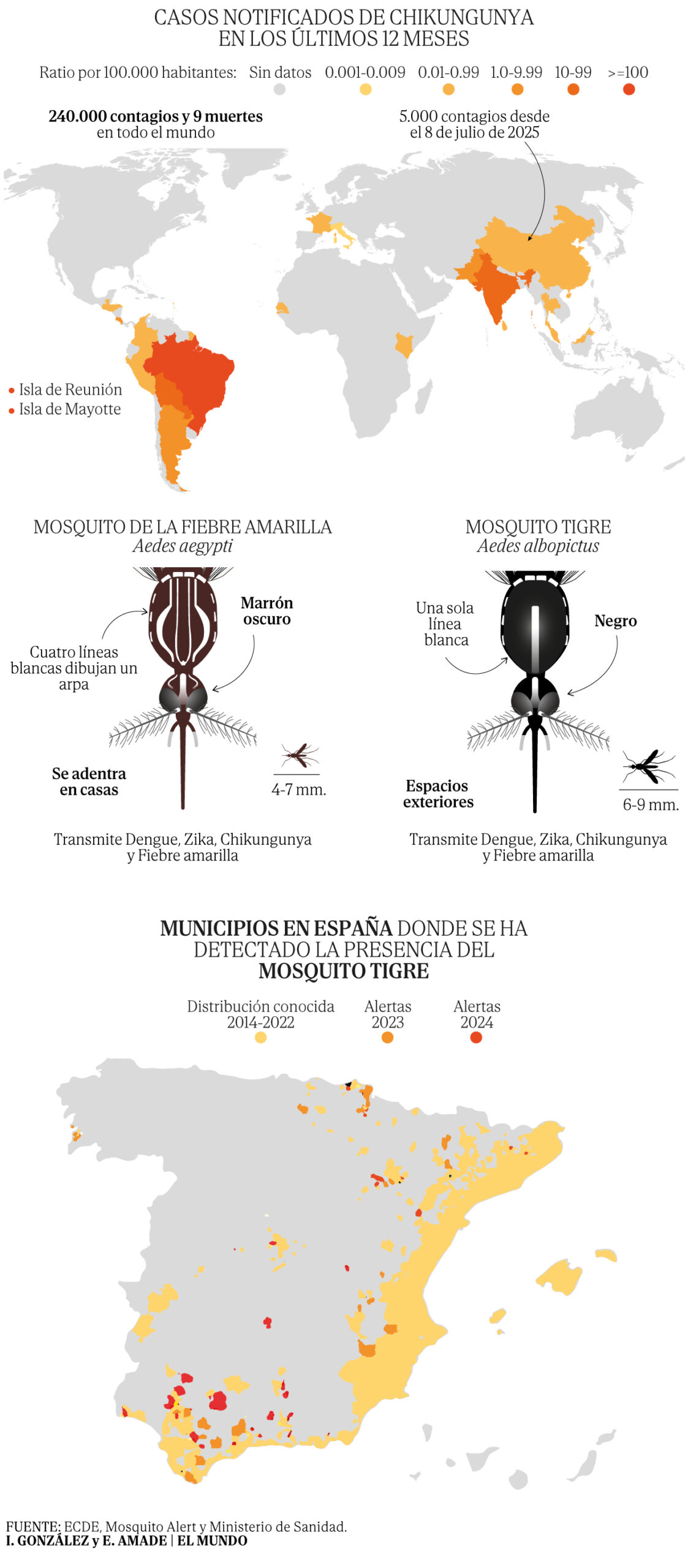
“Everything is under control,” the spokespeople for the Asian nation’s Foreign Ministry reiterated when asked about the travel alerts. Given these concerns, the World Health Organization stated that serious cases and deaths are uncommon and generally occur mainly in babies or older individuals with underlying health issues, particularly when they require hospitalization due to the risk of organ damage. According to European centers for disease prevention and control, until last July, around 240,000 cases of Chikungunya had been registered, including 90 deaths in 16 countries. The countries that reported the greatest number of infections were Brazil, Bolivia, Argentina, and Peru.
Experts have noted that the Chikungunya outbreak in Foshan is the largest since its emergence in China in 2008, although the virus was first identified in Tanzania in 1952. Its name derives from a word from the language of the Makonde, a tribe in this African country, meaning “what is folded,” due to the intense pain it can cause. The first case in the Asian country was identified on July 8, in a citizen returning from abroad.