
## Political Uncertainty in Peru: Analyzing the Electoral Landscape
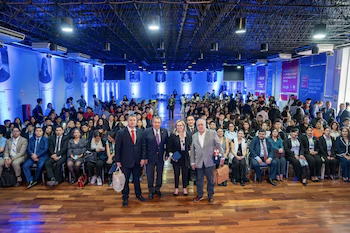
Amid political uncertainty following the first round of elections on April 12, experts emphasized the crucial nature of voting as a pillar of democracy during the V Colloquium “Balance of the First Electoral Round: Path to the Second Round.” Organized by the Faculty of Law and Political Sciences at César Vallejo University (UCV), the event showcased insights from law specialists, journalists, and political analysts, focusing on the institutional challenges facing Peru.
### The Right to Vote: A Fundamental Assurance
José Manuel Villalobos, an electoral law expert, underscored that suffrage is a fundamental right, equivalent to the rights to life and liberty. “The right to vote is a fundamental right, as important as the right to life and liberty,” he asserted, highlighting the necessity of viewing voting as a mechanism for citizens to determine their representatives. Villalobos warned that analyzing electoral processes should extend beyond results to assess any irregularities affecting voter confidence. “A democratic election must not only produce computable results but must also produce trust,” he stressed.
### Evaluating Electoral Irregularities and Their Impact
The colloquium addressed the conditions of the first electoral round, where Villalobos called for a legal evaluation of any irregularities that could influence the results. He noted that the National Election Jury did not allow for complementary elections due to existing legal frameworks that did not foresee such possibilities.
### Citizen Participation: The Drive for Change
Aníbal Quiroga, the dean of the Faculty of Law and Political Sciences at UCV, praised the record participation of citizens, particularly younger voters. “Two point seven million young people voted for the first time,” he noted with enthusiasm. However, he acknowledged existing deficiencies in the electoral process and emphasized the need for improvements ahead of the second round to ensure a legitimate election.
The urgency of securing a legitimate government was also highlighted by Quiroga, who pointed out the unprecedented nature of the sixth consecutive constitutional change, pressing for institutional and democratic consolidation to allay fears of fraud.
### Fragmentation and Distrust in Democracy
Discussions during the colloquium revealed a fragmented political landscape in Peru. Journalist Augusto Álvarez Rodrich stated, “Peru is a fragmented country,” while analyst Mabel Huertas examined governance challenges, emphasizing the necessity for consensus in a bicameral Congress.
### Information: The Key to Democratic Quality
Experts agreed that the quality of democracy correlates to the level of information available to citizens. Quiroga noted gaps in education, connectivity, and informality, while Villalobos pointed out the impact of a weak political-electoral culture, with many voters making decisions based on impulse rather than informed choice.
### The Path Forward: Promoting Informed Voting
Ultimately, participants echoed the importance of promoting informed voting and respecting electoral results. The role of organizations like ONPE and the National Election Jury was deemed critical in safeguarding the exercise of suffrage. The César Vallejo University (UCV) reasserted its commitment to fostering rigorous political analysis and training critically aware citizens.