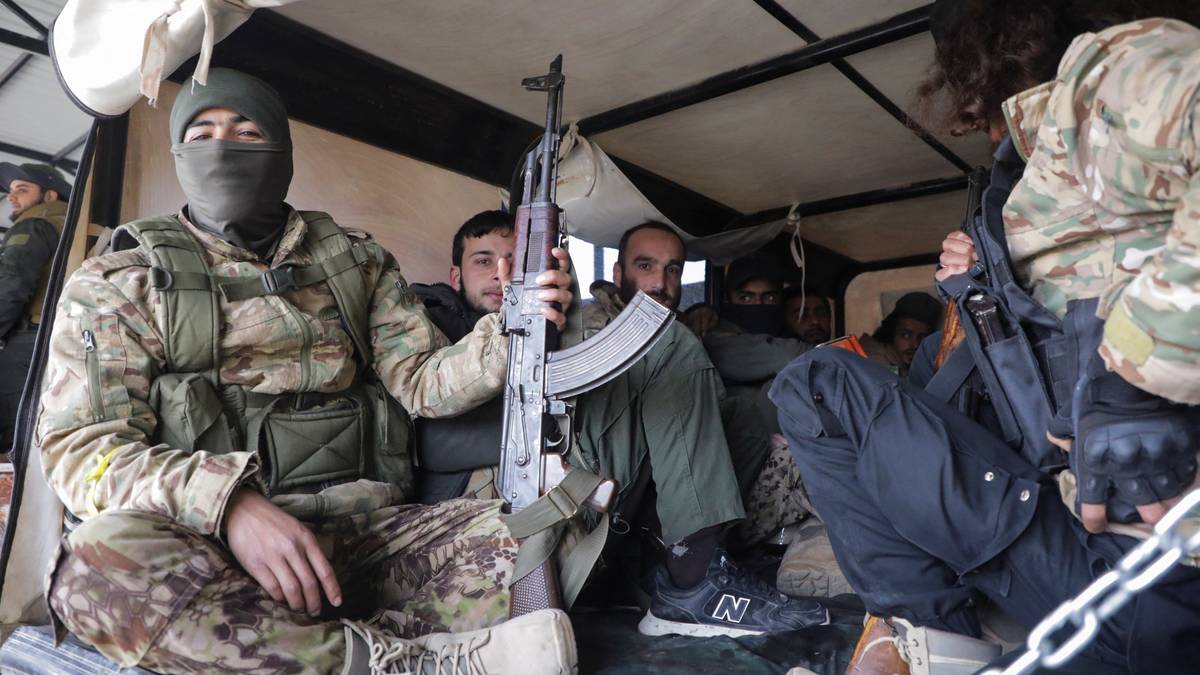
Last week, the world was taken by surprise by the lightning offensive against Aleppo in northern Syria. Since then, the rebels have continued to advance south. According to the Syrian Observatory for Human Rights (SOHR), the rebels in the south now control more than 90 percent of the Deraa region. Deraa is located approximately 10 miles south of the Syrian capital Damascus, and has both strategic and symbolic importance in the country. With the fall of Deraa, President Bashar al-Assad’s forces have surrendered four key areas to the rebels in a week. The red cities are controlled by rebels. The blue ones are under the regime’s control. The rebel groups have therefore gotten close to Damascus, both in the north and in the south, very quickly. – The march starts from the countryside in Homs and Daraa towards the Syrian capital, the rebel forces write on Telegram on Saturday. Below you can read more about what is happening in Syria: Surrounding the capital On Saturday afternoon, there were reports that the rebels have advanced towards Homs, both from the north and the east. The information has come from witnesses, the army and from the rebels themselves. Rebel commander Hassan Badel Ghani says the rebel forces have taken control of a military base and a number of villages around the city, writes Reuters. Homs is the last stop on the road from the north before the Syrian capital. The rebel forces are only 10 kilometers from Damascus, according to SOHR. – Our forces have begun the final phase of encircling the capital, the rebel groups have stated. Syrian Interior Minister Mohammad Khaled al-Rahmoun says on Saturday evening that the defense around the capital is “very strong”. Rebel forces take a photo at one of the water wheels in Hama, after forces captured the city of Hama on December 6. Photo: OMAR HAJ KADOUR / AFP Fighting is ongoing in the countryside both around Homs and Hama, which the forces took control of on Friday. At the same time, SOHR reports that the Syrian military is now withdrawing from small towns around ten kilometers outside the city. The Syrian Ministry of the Interior denies this. – There is no truth in the statements that claim that our forces, which are present in all areas around Damascus, have withdrawn. AP Fighting the Assad regimeGovernment forces Led by President Bashar Al-Assad, he belongs to a Shia Muslim minority that has held power since the 1970s. Russia has supported the rebels by carrying out airstrikes. In addition, they have supplied weapons to Assad and used their veto power in the UN Security Council to block sanctions against the regime. Iran has trained Assad’s forces and supported Hezbollah, which fights on the regime’s side. OMAR HAJ KADOUR / AFP / NTB Fighting against the Assad regime Hayat Tahrir al-Sham (HTS) HTS is a Sunni Muslim military group, founded in 2017, and consists of former Al Qaeda groups. The group has mainly had control in the north of the country, especially Idlib – region. Has made major advances in the last week, and taken over control of cities such as Aleppo and Hama. Approaching Homs. AFP Other actors against the Assad regime The Kurds and the USA There are approximately 2 million Kurds living in Syria. Kurdish groups, especially the YPG, have fought against the Islamic State (IS) and at the same time worked for self-government in their areas of the country. The USA has supported the Kurds in the fight against IS , which has created tension with NATO country Turkey. AP Other actors against the Assad regimeTurkeyTurkey believes that the Kurdish groups are associated with the PKK, a Turkish Kurdish separatist group that Turkey considers a terrorist organisation. Therefore, Turkey has carried out military attacks in northern Syria to weaken these groups. AFP Brief on the civil war in Syria Started in 2011 with protests as part of the Arab Spring. The protests were met with violence by the government forces of the president. Over 500,000 people have lost their lives, and thousands of children have lost their parents. Millions of people have fled to the neighboring countries of Lebanon, Jordan and Turkey. Germany took in around one million Syrian refugees during the refugee crisis in 2015. Strong position in the south Hilde Henriksen Waage, professor of history at UiO and senior researcher at the Institute for Peace Research (Prio), says the rebels’ rapid advance on several fronts is both surprising and not surprising at same time. – These rebel groups have previously failed to cooperate or agree on anything, and have at times also fought each other and switched sides. – But they all agree on one thing, and that is that they want to get rid of Assad. Hilde Henriksen Waage. Photo: Eskil Wie Furunes / news The Syrian army began to withdraw from Deraa on Saturday, in exchange for the soldiers being allowed to return safely to Damascus. Deraa has symbolic meaning as the cradle of the rebellion. – The rebels have had a strong foothold in the south for quite some time, but it is only now that they have suddenly taken control and the government has decided to evacuate its soldiers, says Waage. These are the groups fighting in Syria: Syria’s rebel coalition consists of Islamists and other more moderate factions, who, despite differences, are fighting together against the Assad regime. Hayat Tahrir Al Sham (HTS): The most prominent and largest group is HTS, also known as the Organization for the Liberation of the Levant. HTS was founded by Abu Mohammad al-Jolani, a military commander who previously fought for Al Qaeda in Iraq. HTS has tried to distance itself from Al Qaeda, but many Western countries have categorized the group as a terrorist organization. The Syrian National Army (SNA): The SNA is a collection of several organizations with varying ideologies, united under one banner. The coalition includes the National Liberation Front, which is an Islamist group that aims to establish an Islamic state governed by Sharia law. The Free Syrian Army is also part of the SNA, and is said to have taken control of towns in the north of the Aleppo governorate. In southern Syria, people from the Druze religious minority group have joined the rebel forces. On Friday, the government forces withdrew from the city of Hama in the north. Syria’s defense minister said on Friday that this was a tactical decision, in order to reposition itself. In the east, government forces are said to have also relinquished control of the city of Deir ez-Zor to Kurdish forces. – We have not seen before that the army has given up so easily. The big question is whether they will give up, or whether they will simply focus on protecting Damascus, says Waage. People flee Hama, shortly after rebel forces took control of the city. Photo: Ghaith Alsayed / AP According to Waage, it is clear that Assad, who has been the country’s president since 2000, is now the supreme leader of a weakened regime. Large parts of Syria have been bombed and destroyed for a number of years. The country’s economy is in free fall and poverty is widespread. – At the same time, there have been tough sanctions from the West, which have also turned their attention to other conflicts in the Middle East. Given the situation the country is in, it is no wonder if there is poor morale in the army, says Waage. Syrian rebel forces have captured the city of Deraa in Syria. According to Reuters sources, the military was allowed to withdraw in exchange for a safe passage to the capital Damascus, which is located around 100 km to the north. Known as the birthplace of the uprising against President Bashar al-Assad in 2011, Deraa is the fourth city the government has lost in a week. In addition, Russia, Iran and Hezbollah, allies of Assad, are busy with their own conflicts. – They have not left Syria completely, but pulled out several of their positions, because they are needed elsewhere, she says. – Like choosing between plague and cholera Rebel commander Hassan Abdel Ghani tried on Saturday to reassure religious minorities, who are worried about what will happen if the rebels take over the country. He claims that “the era of tyranny is over”. HTS previously had close ties to Al Qaeda. More recently, HTS has claimed that they have distanced themselves from the group, and that they have renounced their more extreme views. Photo: OMAR HAJ KADOUR / AFP Hilde Henriksen Waage, however, does not think the country will be better served with HTS in the leadership. – HTS is, so to speak, the local team of Al Qaeda. It’s like choosing between plague and cholera, she says of the rebel group and President Assad. However, Waage does not think the rebels will be able to topple the president anytime soon. – Although it is surprising and strange how weak the Syrian government is, there is nothing to indicate that they intend to give up Damascus. – And no modern war can be fought without an air force, which the rebels do not have. If Russia and Iran bring their air force full force, I think the rebels will lose. At the same time, she does not think that either Russia or Iran will sit still in the boat for too long. – Syria is far too important for Russia, as their only ally in the Middle East. Interested in abroad? Listen to the foreign affairs editor’s podcast: Published 07.12.2024, at 08.40 Updated 07.12.2024, at 17.47
ttn-69