
After purchasing a house, acquiring a car often becomes the second largest financial commitment for many individuals. In today’s fast-paced world, a vehicle is not merely a luxury; it is essential for daily tasks such as commuting, running errands, and transporting family. Given the ever-increasing car prices , it becomes imperative to make informed choices. Besides personal preferences and motor specifications, keeping an eye on the most reliable cars is crucial to ensuring a sound investment.
A recent analysis by Consumer Reports serves as a valuable resource in this decision-making process.
Trends in Reliability. Although the study mainly targets the U.S. market, many popular models are available worldwide. Lists from reputable sources like Consumer Reports or JD Power are insightful and influential enough to prompt automakers to take corrective actions based on the findings. Historical issues, such as the problematic rotary engines from Mazda in 1973, underscore the importance of such analyses.
Consumer Reports annually publishes a list of the most reliable car brands , based on consumer surveys and feedback. This year’s report includes insights from 2022 to 2025 , revealing some shifts in rankings. Toyota and Lexus, which have traditionally occupied the top spots, have each dropped one position, making way for Subaru, another Japanese brand known for its dependability.
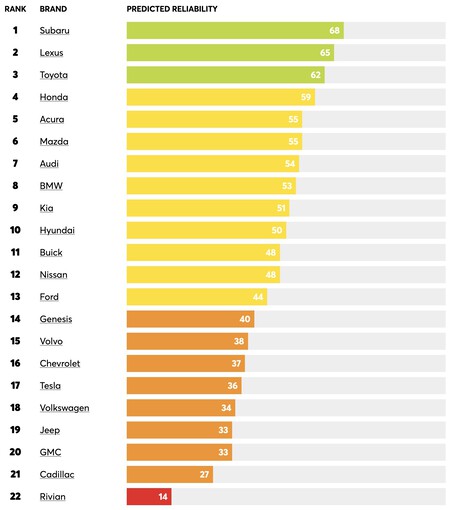
Graph | Consumer Reports
Constant Trends. Japanese brands have consistently dominated the top rankings for reliability, reflecting their commitment to quality. In contrast, the lower tiers of reliability largely feature American automakers, including brands like Jeep, GMC, and Cadillac, which have struggled to maintain their reputation. Additionally, the German manufacturer Volkswagen has faced ongoing reliability issues, while Rivian, once celebrated for its market value, plummeted dramatically by losing 90% of its value in three years .
In the case of brands like Alfa Romeo, Mercedes, Mitsubishi, and Fiat, Consumer Reports pointed out insufficient data to confidently include them in this year’s rankings. This may lead to further changes in the final report for 2025.

Methods of Analysis. The focus of Consumer Reports is based on surveys of their members regarding any issues they have encountered in their vehicles over the past 12 months. The report compiled feedback from over 300,000 vehicles manufactured between 2000 and 2024, including relevant models for 2025.
They evaluate 20 problem areas , ranging from mechanical glitches to battery issues, compiling a score for each vehicle on a scale from 1 to 100. This rigorous methodology ensures that the data is as reliable as the vehicles themselves.
Hybrids on the Rise. Notably, this year, the report revealed that hybrid vehicles are displaying significant improvement in reliability. Jake Fisher, Technical Director of Tests at Consumer Reports, emphasizes that “hybrids continue to excel in fuel efficiency while offering reliability comparable to traditional combustion engines.” Outstanding models include the Toyota Corolla , RAV4 , Kia Elantra , and Hyundai Sorento .
With Caution. However, it’s crucial to note that not all hybrids are equally reliable. Ford’s F-15 and F-150 hybrids, for instance, show significant reliability issues. The report also highlights that pure hybrids rank higher than plug-in hybrids in reliability metrics.
Lastly, Consumer Reports advises that while a brand may enjoy a high reliability rating , variability exists among individual models. For instance, the Toyota BZ4X significantly drags down Toyota’s overall reliability score, also impacting Subaru since the BZ4X is the basis for Subaru’s related model.
As such, armed with the insights from reliable sources, potential car buyers can make informed decisions, ensuring that their vehicle choice will meet their needs for reliability and performance. The evolving landscape of vehicle reliability affirms the importance of staying updated with annual reports and consumer feedback to navigate this vital investment wisely.